|
Broncos Pulse
|
The Road to (18-1): The Only Loss (PT2) |
 
 BACK TO BACK: Broncos win AFC West. And the AFC. And PFT. Chargers sweep '05 AFC West Champs; then are the 1 in (18-1) for '06 AFC West Champs. But a Super Bowl helps. by Woody Paige, Mile High Report
in association with the Denver Gazette
May 11th, 2007
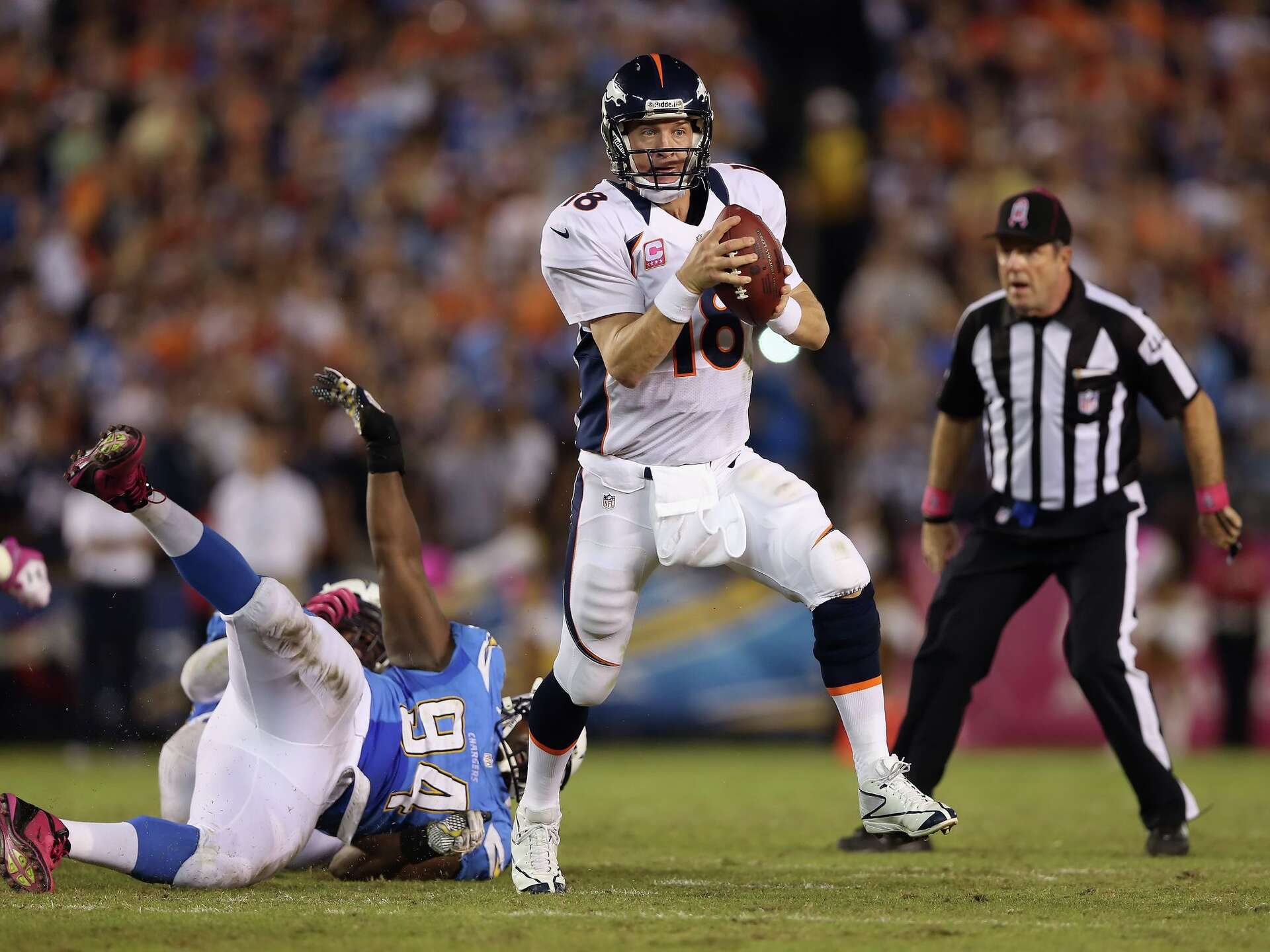 
Three losses haunted the '05 Broncos - but the '06 team made sure to leave it all the field. Champions! #FOREVER
==================
Opening Remarks
==================
The Post-Manning Bowl stretch was wild. At this point, we knew the Broncos were a threat. "Cancel the season", some said. But there was a lot of football left to be played. And while the Broncos had faced some challenges, they had yet to need to RESPOND to heartbreak or something not going their way. How could they weather that storm? Would tough times even show up? Let's find out.
==============================
W eek Twelve (11-0)
 Denver Broncos @ Denver Broncos @ Chicago Bears 
LUCKY BEAN: Denver Broncos escape Chi-Town still undefeated.
CHICAGO– In a brisk, 42-degree afternoon contest played under fair skies with a mild 7 mph breeze, the Denver Broncos put on an offensive aerial display to overpower the Chicago Bears by a final score of 37 to 20. Behind a majestic 473-yard, 3-touchdown passing performance from veteran quarterback Peyton Manning, Denver’s high-octane offense consistently carved up the Chicago defense, amassing an eye-popping 531 total yards of offense and controlling the ball for nearly 26 minutes. Although Chicago’s star running back Frank Gore provided secondary fireworks with two second-half touchdown runs—including an explosive 65-yard sprint—the Bears simply could not keep pace with Denver’s unrelenting rhythm and elite third-down conversion rate. Denver established control early with steady scoring drives, building a commanding 20 to 6 lead by halftime before sealing the road victory with a late pick-six.
The game’s narrative was defined by Peyton Manning’s complete mastery of the passing game. Manning completed 28 of 48 pass attempts for 473 yards, 3 touchdowns, and 2 interceptions, registering a passer rating of 95.2 and an average of 9.85 yards per attempt. Operating comfortably behind solid pass protection, Manning repeatedly pinpointed holes in the Chicago secondary, connecting on deep vertical routes, intermediate crossers, and lethal passes out of the backfield. Manning spread the ball across seven targets, but his primary weapon throughout the contest was dynamic running back Ronnie Brown, who earned Offensive Player of the Game honors with a 24-point display. Brown was virtually unmatchable, catching 8 passes for 165 yards and 2 touchdowns, including a long reception of 53 yards and 19 yards created after the catch. Brown proved to be Manning’s most lethal red-zone target, catching touchdown passes of 1 yard and 9 yards while consistently moving the chains on third down.
Opposing Manning under center for Chicago was Billy Volek, who found himself under constant pressure from Denver's front four and tight coverage in the secondary. Volek endured a grueling afternoon, completing just 10 of 26 passes for 205 yards, 0 touchdowns, and 1 interception for a 51.0 passer rating. Volek’s 38.46% completion percentage reflected Chicago's inability to establish rhythm in the passing game, though he did manage a couple of big downfield strikes, including a 50-yard connection to Dez White and a 32-yard gain to Andre Johnson.
On the ground, Denver intentionally leaned into the pass, accumulating 65 rushing yards on 23 carries for a 2.83 average. Ron Dayne shouldered the bulk of the interior rushing workload, carrying 14 times for 50 yards with a long run of 10 yards. Backup P.J. Pope added 12 yards on 6 attempts, Rock Cartwright had 1 rush for 4 yards, Jabar Gaffney gained 0 yards on an attempt, and Peyton Manning lost 1 yard on a late kneel-down. In contrast, Chicago generated almost all of its offensive identity through Frank Gore, who produced a stellar game despite the loss. Gore rushed 19 times for 129 yards and 2 touchdowns, averaging a remarkable 6.79 yards per carry. Fullback J.T. Wall added 3 yards on 2 carries, and Brad Hoover gained 2 yards on his sole attempt, giving Chicago 134 rushing yards on 22 attempts.
The scoring action opened in the first quarter with both defenses establishing a physical presence early. Chicago claimed the initial scoreboard advantage after Billy Volek engineered a 6-play, 73-yard drive over 3:35, culminating in a 53-yard field goal by Paul Edinger with 4:21 left in the opening period. Denver responded immediately on its next possession as Manning marched the Broncos 78 yards across 9 plays in 3:10, leading to a 23-yard field goal from Jeff Reed to tie the score at 3 to 3 with 1:11 remaining in the first quarter.
Denver blew the game open in the second quarter with a 17-point explosion. Manning executed a rapid 4-play, 75-yard drive in just 57 seconds, highlighted by a 53-yard pass to Ronnie Brown that set up a 1-yard touchdown pass from Manning to Brown to make it 10 to 3. Chicago answered with a 6-play, 85-yard drive that resulted in a 48-yard field goal by Paul Edinger, cutting the score to 10 to 6. Denver then pieced together a 9-play, 86-yard drive capped by a 19-yard field goal from Jeff Reed to increase the lead to 13 to 6. With under a minute left in the half, Manning launched a deep pass down the right sideline to Marty Booker for a stunning 58-yard touchdown strike, sending Denver into halftime ahead 20 to 6.
Denver kept the pressure on in the third quarter, taking the opening kickoff and mounting a 13-play, 67-yard drive that consumed 5:46 off the clock. Manning capped the possession with a 9-yard touchdown pass to Ronnie Brown, extending Denver's lead to 27 to 6. Chicago refused to fold quietly, as Frank Gore sparked the Bears with four consecutive carries on a 7-play, 75-yard drive, concluding with a 3-yard touchdown rush by Gore to make it 27 to 13 with 2:32 left in the third period.
In the fourth quarter, Denver pushed its lead back to seventeen when Jeff Reed drilled a 26-yard field goal to cap a 10-play, 76-yard drive. Chicago answered rapidly when Frank Gore broke through a seam at the line of scrimmage and outran the secondary for a breathtaking 65-yard touchdown run, capping a 3-play, 95-yard drive to bring the Bears within ten points at 30 to 20 with 5:17 remaining. However, as Chicago attempted a comeback, Denver defensive back Ken Hamlin intercepted a Billy Volek pass at the 15-yard line and returned it 15 yards for a touchdown with 1:50 left, sealing Denver's 37 to 20 victory.
Denver's receiving group featured giant individual performances alongside Ronnie Brown's 165 yards. Marty Booker caught 6 passes for 161 yards and a touchdown, averaging 26.83 yards per catch with 64 yards after the catch. Jabar Gaffney hauled in 5 receptions for 65 yards, Rock Cartwright caught 4 passes for 31 yards out of the backfield, Daniel Graham added 3 catches for 24 yards, Wes Welker logged a 19-yard reception, and Adam Bergen contributed an 8-yard catch. For Chicago, Andre Johnson led all receivers with 4 catches for 104 yards, Dez White caught 1 pass for 50 yards, David Terrell logged 3 receptions for 26 yards, Heath Miller added 1 catch for 16 yards, and Frank Gore caught 1 pass for 9 yards.
Defensively, Denver was led by middle linebacker Al Wilson, who recorded a game-high 9 tackles, including 2 tackles for loss and 1 pass deflection. Free safety Ken Hamlin was awarded Defensive Player of the Game honors for Denver after compiling 6 tackles, 1 pass deflection, and the crucial 15-yard interception return touchdown. Hanik Milligan recorded 4 tackles, Leroy Hill logged 3 tackles with 2 for loss, Vincent Fuller added 3 tackles, and David Macklin posted 3 tackles and 2 pass deflections. Defensive ends Matt Walters and Victor Adeyanju each registered a sack against Volek. For Chicago, cornerbacks Asante Samuel and Joey Porter led the effort with 7 tackles each, while Keyaron Fox recorded 6 tackles and 3 tackles for loss. Donte Whitner and Rashard Anderson each intercepted a Manning pass for Chicago, while Russell Davis and LaDairis Jackson each recorded a sack.
Special teams execution was spotless for Denver. Placekicker Jeff Reed went 3-for-3 on field goal attempts (23, 19, and 26 yards) and converted all 4 extra point attempts for 13 total points. Chicago kicker Paul Edinger converted both of his long field goal attempts (53 and 48 yards) along with 2 extra points. In the return game, Denver's Aveion Cason returned 5 kickoffs for 124 yards (24.80 average) with a long of 31 yards, while Chicago's Andre' Davis fielded 8 kickoffs for 182 yards (22.75 average). Denver punter Brian Moorman punted twice for 77 yards (38.50 average), while Chicago's Austin Herbert punted 6 times for 244 yards (40.67 average).
The final statistical breakdown highlighted Denver's complete command of the game. Denver earned 23 first downs compared to just 8 for Chicago, while dominating total yardage 531 to 329. Denver converted an outstanding 10 of 15 third-down attempts (66.67%), whereas Chicago managed only 3 conversions on 12 attempts (25.00%). Denver was a perfect 5-for-5 in red-zone scoring opportunities (2 touchdowns, 3 field goals) and committed only 1 penalty for 5 yards, compared to Chicago's 6 penalties for 43 yards. Possessing the football for 25:55 to Chicago's 18:05, Denver rode Peyton Manning's arm and a disciplined defensive effort to a convincing 37 to 20 triumph.
==============================
W eek Thirteen (12-0)
Denver Broncos @ Oakland Raiders 
THE BLACK HOLE BLEEDS ORANGE: Peyton Manning’s 4-TDs Power Broncos in Rout Over Raiders
OAKLAND – Under ideal football conditions featuring clear, fair skies, mild 57-degree temperatures, and virtually no wind, the Denver Broncos put on a clinical display of complementary football to crush their division rivals, the Oakland Raiders, by a decisive 38 to 7 margin. From the opening kickoff, Denver established absolute authority on both sides of the ball, unleashing a high-octane aerial attack led by Peyton Manning while deploying a suffocating defense that held Oakland scoreless across the first three quarters. Denver opened up a 14 to 0 first-quarter lead, expanded it to 24 to 0 by halftime, and built a massive 38 to 0 cushion before Oakland finally managed a late fourth-quarter touchdown to avoid the shutout. Amassing 443 total yards of offense compared to just 223 for Oakland, Denver dominated third downs, won the time of possession battle by nearly seven minutes, and executed explosive chunk plays that left the Raiders without answers throughout the afternoon.
The game’s offensive star was Denver quarterback Peyton Manning, who delivered a masterclass in downfield passing to earn Offensive Player of the Game honors with 23 points. Manning completed 15 of 30 pass attempts for 298 yards, 4 touchdowns, and 0 interceptions, compiling an outstanding 110.8 passer rating and averaging an explosive 9.93 yards per attempt. Manning’s precision was on full display as he repeatedly punished Oakland’s secondary on deep vertical routes, delivering touchdown strikes of 36, 1, 76, and 62 yards. Late in the contest, backup quarterback Jim Sorgi saw brief action, completing his sole pass attempt to Drew Bledsoe for a 9-yard gain to finish with a 104.2 rating. Together, Denver’s passing game generated 297 net yards, averaging 9.58 yards per attempt across 31 total passes.
Oakland’s passing game, by contrast, was severely limited by relentless pressure from Denver’s front seven and tight coverage in the secondary. Starting quarterback Ty Branyon struggled to find any rhythm, completing 11 of 25 passes for 131 yards, 0 touchdowns, and 1 interception, while absorbing 2 sacks and finishing with a passer rating of 43.9. Backup Drew Bledsoe entered late and went 0-for-3 with an interception, finishing with a 39.6 passer rating. In total, Oakland generated just 120 net passing yards on 28 attempts, averaging a paltry 4.29 yards per attempt as Denver’s defensive backs repeatedly contested throws and disrupted passing lanes.
Complementing Manning’s aerial brilliance was a powerful and efficient Denver ground game that accumulated 146 rushing yards on 27 carries, averaging a robust 5.41 yards per rush. Veteran running back Ron Dayne anchored the interior rushing attack, churning out 90 yards on 15 carries (6.00 average) with a long run of 16 yards. Backup running back P.J. Pope provided a dynamic change of pace, picking up 53 yards on 11 carries (4.82 average) with a long run of 17 yards. Kick returner Aveion Cason added 3 yards on his single rushing attempt, and Denver finished the game without a single fumble.
Oakland’s rushing attack posted respectable overall numbers with 103 yards on 21 carries (4.90 average), but much of that production came after the game was well out of reach. Fullback Casey Moore shouldered the main workload, rushing 15 times for 72 yards (4.80 average) with a long of 12 yards and scoring Oakland’s solitary touchdown in the fourth quarter. Wide receiver Jerry Porter provided Oakland’s longest ground play on a 28-yard trick-play end-around on his only carry. Fullback Tony Richardson and running back Erik Bickerstaff added 4 yards apiece on 2 carries, while quarterback Ty Branyon lost 5 yards on a sack-fumble sequence that Oakland managed to recover.
Denver established control early in the opening quarter behind sharp execution. After forcing a quick Oakland punt, Peyton Manning needed just 5 plays to march the Broncos 80 yards in 1:38. Manning capped the drive by launching a pinpoint 36-yard touchdown pass to receiver Marty Booker, giving Denver a 7 to 0 lead with 9:22 left in the first period after Jeff Reed’s successful extra point. Just minutes later, Denver’s defense delivered a major blow. On Oakland’s next possession, safety Ken Hamlin stepped in front of a Ty Branyon pass, intercepted it, and sped 22 yards down the sideline for a pick-six touchdown. The defensive score capped a 1-play, 23-yard sequence that took just 3 seconds, pushing Denver’s advantage to 14 to 0 with 6:27 remaining in the opening quarter.
The second quarter saw Denver extend its lead through a combination of grinding drives and big-play passing. Kicker Jeff Reed completed an 8-play, 75-yard drive that consumed 4:07 by drilling a 32-yard field goal, increasing the margin to 17 to 0 with 10:24 left before halftime. Late in the period, Manning engineered a crisp 11-play, 54-yard march taking 4:03 off the clock. On third-and-goal from the 1-yard line, Manning play-faked and flipped a 1-yard touchdown pass to Marty Booker with just 0:53 left in the quarter. Reed’s extra point sent Denver into the locker room with a commanding 24 to 0 halftime cushion.
Coming out of halftime, Denver put the game completely out of reach with two rapid lightning-strike scoring drives in the third quarter. Midway through the period, Manning took over at his own 24-yard line and executed a 2-play, 76-yard drive that took only 20 seconds. Manning dropped back and hit wideout Jabar Gaffney in stride down the seam for a breathtaking 76-yard touchdown strike, extending the lead to 31 to 0 with 6:20 remaining in the third quarter. Late in the quarter, Manning delivered another highlight-reel play, needing just 1 play and 16 seconds to strike again. Connective pass-catching tailback Ronnie Brown caught a screen pass from Manning, broke two tackles near the line of scrimmage, and accelerated down the sideline for a 62-yard touchdown catch-and-run. Reed’s conversion pushed the lead to 38 to 0 with 0:12 left in the third quarter.
Oakland finally managed to break the shutout in the fourth quarter against Denver’s backup defenders. Driving 61 yards across 6 plays in 1:52, the Raiders moved into the red zone behind runs from Casey Moore and a penalty against Denver. Moore capped the possession with a 1-yard touchdown plunge with 2:26 remaining in the contest. Sebastian Janikowski added the extra point to bring the final score to 38 to 7.
Denver’s pass catchers put up efficient and explosive receiving numbers across the board. Jabar Gaffney led Denver in receiving yards, catching 4 passes for 120 yards and a 76-yard touchdown, averaging an incredible 30.00 yards per catch with 75 yards after the catch. Ronnie Brown was equally devastating as a receiving option out of the backfield, hauling in a team-high 6 receptions for 106 yards and a 62-yard touchdown, generating 50 yards after the catch. Marty Booker served as Manning’s primary red-zone target, catching 3 passes for 45 yards and 2 touchdowns (long of 36). Ron Dayne caught 1 pass for 13 yards, David Martin caught 1 pass for 12 yards, and tight end Daniel Graham added 1 catch for 11 yards.
For Oakland, wide receiver Peter Warrick led the pass-catching unit with 3 receptions for 59 yards (long of 37) and 19 yards after the catch. Jerry Porter added 3 receptions for 32 yards (long of 17), while tight end Leonard Pope caught 3 passes for 31 yards (long of 26). Kick returner David Brown hauled in 1 reception for 7 yards, and fullback Tony Richardson recorded 1 catch for 2 yards.
Denver’s offensive line physically dominated the trenches, allowing Manning ample time in the pocket while clearing large rushing lanes. Guard Elton Brown led the team with an astounding 10 pancake blocks without allowing a sack. Brad Meester recorded 8 pancake blocks, Scott Wells logged 7 pancakes, and Dustin Rykert added 5 pancake blocks (though allowing 1 sack). Rock Cartwright and Robert Gallery each recorded 3 pancake blocks, while Marty Booker and Daniel Graham logged 2 pancakes apiece, and Ron Dayne and David Martin chipped in 1 pancake block each. Oakland’s blocking unit was led by tight end Leonard Pope with 5 pancake blocks, followed by John Tait, Langston Walker, and Chris Kemoeatu with 4 pancakes each. Tarik Glenn and Jeremy Newberry each added 3 pancakes, while Tony Richardson had 2, and Erik Bickerstaff and Adam Kieft each logged 1 pancake block. Oakland’s line allowed 3 sacks on the day, with Walker and Glenn each credited with 1 sack allowed.
Denver’s defense delivered a total team performance, harassing Oakland’s quarterbacks and controlling the line of scrimmage. Free safety Ken Hamlin led the secondary with 6 tackles, 1 pass deflection, and the key 22-yard interception return touchdown. Linebacker Leroy Hill logged 6 tackles (5 solo, 1 for loss), while cornerback David Macklin recorded 5 tackles and 1 pass deflection. Antwan Peek and Al Wilson each logged 4 tackles, with Wilson adding a game-high 4 pass deflections. Defensive back Vincent Fuller and linebacker Charlie Anderson each added 3 tackles. In the pass rush, Denver registered 3 sacks: defensive end Matt Walters had 2 tackles and 1 sack, rookie Victor Adeyanju recorded 1 tackle and 1 sack, and cornerback Stanford Routt added 1 tackle, 1 sack, and 2 pass deflections. Hanik Milligan, DeMario Minter, Shawn Springs, Ko Simpson, Chris Hovan, and Marty Booker each contributed tackles to complete the defensive effort.
Oakland’s defense was led by middle linebacker Napoleon Harris, who earned Defensive Player of the Game honors with 14 points after compiling 8 tackles (7 solo, 1 for loss) and intercepting a pass, which he returned 5 yards. Cornerback Jason Webster posted a game-high 9 tackles (8 solo, 1 for loss) alongside 2 pass deflections. Linebacker Dontarrious Thomas recorded 5 tackles (4 solo, 1 for loss), while safety Pierson Prioleau logged 4 tackles. Rashad Washington, Manny Lawson, Shurron Pierson, and Ike Taylor each recorded 3 tackles, with Washington deflecting 3 passes and Pierson recording 1 sack. Amon Gordon, Peter Sirmon, and Shaun Williams each added 2 tackles, with Williams deflecting 3 passes. Tim Wansley added 1 tackle and Oakland’s second sack on Manning, while Jarvis Green logged 1 tackle.
Special teams execution was dominant for Denver. Placekicker Jeff Reed was perfect on the afternoon, converting his only field goal attempt from 32 yards and making all 5 extra point attempts for 8 total points. Punter Brian Moorman was exceptional, averaging 47.80 yards across 5 punts (239 total yards) with a long of 53 yards, placing 2 punts inside the 20-yard line with 0 touchbacks. Aveion Cason handled return duties for Denver, returning 3 punts for 21 yards (7.00 average, long of 8 ) while not returning any kickoffs.
For Oakland, kicker Sebastian Janikowski converted his lone extra point attempt and kicked off twice with 2 touchbacks. Punter Mat McBriar had a heavy workload, punting 10 times for 372 yards (37.20 average) with a long of 51 yards, placing 3 punts inside the 20-yard line. David Brown returned 7 kickoffs for 173 yards (24.71 average) with a long return of 37 yards, while Chad Morton had 1 punt return for 2 yards.
In the final team statistical summary, Denver outclassed Oakland in virtually every major metric. Denver collected 16 first downs compared to Oakland’s 9. Third-down efficiency was a decisive factor: Denver converted 5 of 11 third-down attempts (45.45%), while Oakland’s offense was completely stymied, converting just 1 of 13 third downs (7.69%). Denver was efficient in the red zone, scoring on both of its trips (1 touchdown, 1 field goal) for a 100% conversion rate, matching Oakland’s 1-for-1 red-zone touchdown performance. Denver dominated time of possession, holding the ball for 25:22 compared to Oakland’s 18:38. Penalties were relatively clean on both sides, with Denver committing 4 penalties for 35 yards and Oakland drawing 3 penalties for 22 yards. Turnovers were even at 1 apiece, but Denver directly capitalized on its takeaway with Hamlin’s pick-six, sealing a comprehensive 38 to 7 victory over their divisional rivals.
==============================
W eek Fourteen (13-0)
 Kansas City Chiefs @ Denver Broncos
SUPER RONNIE: Manning and Brown Unleash Historical 5-TD Aerial Explosion in Rout of Chiefs
DENVER – In a chilly, 42-degree afternoon contest played under clear skies with a gentle 2 mph breeze, the Denver Broncos put on one of the most prolific single-game offensive passing showcases in league history to obliterate the Kansas City Chiefs by a final score of 56 to 21. Behind an iconic, record-shattering connection between quarterback Peyton Manning and dynamic pass-catcher Ronnie Brown, Denver blew open a non-competitive affair early, opening up a commanding 35 to 0 lead by halftime and extending the margin to 56 to 7 before a pair of late fourth-quarter consolation touchdowns softened the final deficit for Kansas City. Despite Kansas City holding a significant advantage in total time of possession (26:03 to 17:57) and running 70 offensive plays to Denver’s 49, the Broncos operated at a historically efficient pace. Averaging an astonishing 10.88 yards per play across the entire game, Denver needed only 26 pass attempts to rack up 459 passing yards and 5 touchdowns, scoring virtually every time they touched the football on deep, explosive vertical routes that completely overwhelmed the Kansas City secondary.
The game’s narrative was unequivocally defined by the jaw-dropping partnership between Peyton Manning and Ronnie Brown, who combined to put together an all-time record receiving performance. Manning was near-flawless under center, completing 17 of 26 pass attempts for 459 yards, 5 touchdowns, and 1 interception, finishing with a 132.2 passer rating and an unheard-of 17.65 yards per pass attempt. His primary beneficiary was Brown, who captured Offensive Player of the Game honors with an eye-popping 58-point evaluation. Brown hauled in 12 receptions for 415 receiving yards and 5 touchdowns, averaging a staggering 34.58 yards per catch while generating 115 yards after the catch. Time and again, Manning audibled at the line of scrimmage, recognized single coverage on the perimeter or down the seam, and lofted deep passes that Brown gathered in stride before outrunning the Chiefs' secondary. Brown scored on touchdown receptions of 55, 34, 49, 64, and 53 yards, accounting for almost all of Denver’s aerial damage in a historic display of big-play dominance.
Opposing Manning for Kansas City was Byron Leftwich, who endured a grueling, high-volume afternoon under relentless pressure from Denver's defense. Leftwich completed 21 of 45 pass attempts for 234 yards, 3 touchdowns, and 3 interceptions, absorbing 3 sacks and ending the game with a 57.1 passer rating. While Leftwich threw for three touchdowns late in the game to tight end Alge Crumpler, his three costly interceptions were directly turned into short fields and rapid touchdown drives by the Denver offense. Kansas City tried to keep the game manageable on the ground through running back Travis Henry, who carried 21 times for 66 yards (3.14 average) with a long of 9 yards, but the growing scoreboard deficit forced the Chiefs to abandon the run early in the second half. Cedric Benson added 12 yards on 4 carries (3.00 average), bringing Kansas City’s ground total to 78 yards on 25 carries.
Denver’s ground game was intentionally secondary to their lethal passing attack, but it was highly effective in short-yardage and red-zone situations. Running back P.J. Pope led the backfield workload, rushing 21 times for 69 yards and 3 short-yardage touchdowns, including a long run of 22 yards. Fullback Rock Cartwright added 8 yards on his sole carry, while Aveion Cason lost 3 yards on his only attempt, giving Denver a final team total of 74 rushing yards on 23 carries (3.22 average). Though the rushing totals were modest, Pope's efficiency inside the 5-yard line gave Denver complete red-zone dominance, scoring on all three of their inside-the-twenty opportunities.
The scoring cascade began midway through the first quarter after Denver’s defense forced a prompt punt. Taking over at their own 45-yard line, Peyton Manning needed only 2 plays and 15 seconds to strike. Manning dropped back and hit Ronnie Brown along the left sideline for a 55-yard touchdown pass with 7:57 left in the opening frame, making it 7 to 0 after Jeff Reed’s extra point. On Denver's next possession, Manning executed a 4-play, 72-yard drive in 2:04, finding Brown again for a 34-yard touchdown pass to make it 14 to 0 with 4:42 left in the first quarter.
Denver expanded its lead into a runaway blow-out during the second quarter, racking up 21 unanswered points. Just under two minutes into the period, Manning uncorked a 49-yard touchdown pass to Ronnie Brown to complete a 2-play, 91-yard drive that took just 47 seconds, pushing the lead to 21 to 0 with 9:03 left before halftime. Following a Kansas City interception, Denver marched 80 yards in 5 plays, capped by a 5-yard touchdown rush from P.J. Pope with 3:36 remaining. Less than three minutes later, after another Chiefs turnover set up Denver with a short field at the 25-yard line, Pope capped a 5-play drive with a 3-yard touchdown run at the 0:57 mark, sending the Broncos into the locker room with a insurmountable 35 to 0 halftime lead.
The third quarter saw Denver maintain its firm grip on the contest. After a defensive stop, P.J. Pope capped a 5-play, 23-yard drive with his third touchdown run of the day, extending Denver's advantage to 42 to 0 with 8:59 left in the third quarter. Kansas City finally got on the board late in the third period when Byron Leftwich orchestrated a 15-play, 79-yard march that consumed nearly seven minutes, concluding with a 6-yard touchdown pass to tight end Alge Crumpler to make it 42 to 7 with 2:02 remaining in the quarter.
Any hopes of a Kansas City comeback were instantly snuffed out in the fourth quarter as Manning and Brown re-ignited their deep vertical connection. On the first play of their next possession, Manning launched a deep ball to Brown, who sprinted 64 yards for his fourth touchdown catch of the afternoon, extending the lead to 49 to 7 with 9:56 left in the game. Two minutes later, following another defensive interception, Manning and Brown hooked up one final time on a 3-play, 69-yard drive that ended with a 53-yard touchdown catch-and-run, bringing the score to 56 to 7 with 7:56 remaining. Kansas City added two late touchdown passes from Leftwich to Crumpler—a 4-yard strike with 2:56 left and a 44-yard touchdown pass with 0:22 remaining—to close out the scoring at 56 to 21.
Beyond Ronnie Brown's legendary 415-yard, 5-touchdown outing, Denver's remaining pass catchers played minimal roles due to the overwhelming target share funneling to Brown. Marty Booker caught 2 passes for 15 yards (long of 10), Wes Welker hauled in 1 pass for 14 yards, Daniel Graham added a 10-yard reception, and P.J. Pope caught 1 pass for 5 yards. For Kansas City, Alge Crumpler was the lone bright spot on offense, hauling in 7 receptions for 96 yards and 3 touchdowns, generating 35 yards after the catch. Marcus Maxwell caught 4 passes for 46 yards (long of 16), Albert Johnson logged 3 catches for 34 yards, Samie Parker had 3 receptions for 30 yards, and Rasheed Marshall chipped in 4 catches for 28 yards.
Denver’s offensive line provided elite protection for Manning, failing to allow a single sack across 26 pass attempts while opening up crucial red-zone running lanes. Right tackle Dustin Rykert led the blocking unit with 5 pancake blocks. Center Brad Meester, tight end Daniel Graham, and fullback Rock Cartwright each recorded 4 pancake blocks. Tackle Willie Roaf and guard Robert Gallery logged 3 pancake blocks apiece, while guard Scott Wells added 2 pancakes, and Marty Booker, Adam Bergen, and Ronnie Brown each added 1 pancake block. Kansas City’s offensive line allowed 3 sacks on Leftwich, with Alex Stepanovich, Mo Collins, and Tyson Clabo each surrendering 1 sack. Alge Crumpler led the Chiefs in blocking with 6 pancake blocks, followed by Stepanovich, Kris Wilson, and Kevin Boothe with 3 pancakes each. Defensively, Denver was led by middle linebacker Al Wilson, who earned Defensive Player of the Game honors with 16 points after compiling 8 tackles (1 for loss), 1 pass deflection, 1 hit, and 1 interception which he returned 4 yards.
Defensive back Vincent Fuller tied Wilson for the team lead with 8 solo tackles and added a pass deflection. Safety Hanik Milligan recorded 6 solo tackles, while Leroy Hill and Ken Hamlin each logged 4 tackles and combined for 3 pass deflections. Cornerback Shawn Springs posted 4 tackles and intercepted a pass, returning it 8 yards. Cornerback David Macklin was exceptional in coverage, making 3 tackles, deflecting 4 passes, and picking off a pass that he returned 31 yards. In the pass rush, Denver generated 3 sacks, courtesy of Tamba Hali (3 tackles, 1 sack), Chris Hovan (3 tackles, 1 sack), and Matt Walters (2 tackles, 1 sack). Stanford Routt and Charlie Anderson each contributed 3 tackles, while Antwan Peek added 2 tackles.
Kansas City’s defense was led by linebacker Clint Ingram, who posted 7 tackles (1 for loss) and 2 pass deflections. Linebacker Kendrell Bell and cornerback Jimmy Williams recorded 5 tackles each, with Williams making 8 hits. Safety James Sanders added 4 tackles, while Charles Tillman, Derrick Johnson, and D'Qwell Jackson each logged 3 tackles. Jackson also recorded Kansas City's only takeaway on the day, intercepting a Manning pass in the second half.
Special teams play was clean and effective for Denver. Kicker Jeff Reed was flawless on extra points, converting all 8 of his attempts to finish with 8 points while kicking off 9 times. Punter Brian Moorman punted 5 times for 209 yards (41.80 average) with a long of 48 yards, pinning 2 punts inside the 20-yard line. Aveion Cason returned 4 punts for 13 yards (3.25 average) and 2 kickoffs for 49 yards (24.50 average). Ronnie Brown also contributed on special teams, returning a kickoff for 18 yards. For Kansas City, kicker Jay Feely went 3-for-3 on extra points, while punter Travis Dorsch punted 7 times for 347 yards (49.57 average) with a long of 59 yards. Albert Johnson handled kickoff return duties for the Chiefs, returning 9 kickoffs for 185 yards (20.56 average) with a long of 29 yards.
The final team statistics underscored the unique nature of Denver's overwhelming victory. Kansas City actually led in first downs (16 to 10) and third-down conversions (7 of 16 for 43.75% compared to Denver's 3 of 8 for 37.50%), largely due to their high play volume while chasing the game. However, Denver outgained Kansas City in total yards by a massive 533 to 299 margin while averaging more than double Kansas City's yards per play (10.88 to 4.27). Denver won the turnover battle 4 to 1, capitalizing on Kansas City's mistakes to continuously create easy scoring opportunities. Despite drawing 8 penalties for 77 yards compared to Kansas City's 5 penalties for 35 yards, Denver’s explosive vertical passing game easily rendered those yardage setbacks irrelevant, capping a dominant 56 to 21 triumph over their AFC West foes.
==============================
W eek Fourteen (14-0)
Denver Broncos @ Houston Texans 
BIGGER IN TEXAS: Broncos Prevail Over Texans in Late-Game Thriller
HOUSTON – On a warm, 78-degree afternoon played under fair skies with zero wind, the Denver Broncos outlasted the Houston Texans in an absolute offensive shootout, earning a dramatic 40 to 37 victory. The high-scoring battle featured six lead changes, a total of 981 combined offensive yards, and a chaotic fourth quarter that came down to the final minute of regulation. Denver established an early edge behind kicking accuracy and methodical movement, took a 13 to 3 second-quarter lead, but suddenly found itself trailing 20 to 16 at halftime following an explosive burst by the Houston passing attack. The teams exchanged body blows throughout the second half, with Denver reclaiming the lead at 30 to 23 in the third period and later breaking a 30-all tie in the final frame. After Houston briefly snatched a 37 to 33 advantage with under two minutes remaining, Denver executed a rapid seven-play drive capped by a game-winning touchdown pass with just 51 seconds left on the clock.
The narrative of Denver’s offensive production was defined by a two-quarterback rotation between Peyton Manning and Drew Bledsoe, who combined to generate 402 net passing yards and 3 touchdown passes on 27-of-40 passing. Drew Bledsoe handled the majority of the passing snaps, completing 17 of 27 passes for 270 yards, 1 touchdown, and 1 interception, finishing with a 105.5 passer rating and an average of 10.00 yards per attempt. Peyton Manning was exceptionally efficient during his time under center, completing 10 of 13 pass attempts for 144 yards, 2 touchdowns, and 0 interceptions to record a 138.0 passer rating and 11.08 yards per attempt. Together, the duo repeatedly carved up Houston’s secondary on deep vertical routes and intermediate crossing patterns, keeping Denver’s offense in constant rhythm despite offering minimal ground support.
Houston answered Denver’s passing output with an explosive aerial showcase of its own, generating 460 net passing yards and 4 touchdowns on 22 completions. Starting quarterback Philip Rivers spearheaded the effort, connecting on 19 of 35 passes for 415 yards, 3 touchdowns, and 2 interceptions to post a 101.5 passer rating and a massive 11.86 yards per attempt. Backing up Rivers, David Carr was called upon for a brief stint, completing 3 of 4 passes for 47 yards, 1 touchdown, and 1 interception for a 113.5 rating. Despite their vertical potency—highlighted by touchdown strikes of 78, 63, 26, and 12 yards—Houston’s quarterbacks were plagued by three costly interceptions that ultimately provided Denver with crucial short fields and extra possessions.
Both ground attacks were largely rendered secondary by the frantic passing pace, as both teams struggled to establish consistent push at the line of scrimmage. Denver managed 56 rushing yards on 21 carries (2.67 average), anchored by power back Ron Dayne, who gained 49 yards and a touchdown on 12 carries (4.08 average) with a long run of 14 yards. Fullback Rock Cartwright and backup P.J. Pope added 5 yards each on 2 and 4 carries respectively, while Drew Bledsoe lost 3 yards on late clock-management attempts. Houston posted nearly identical rushing figures, accumulating 63 yards on 21 carries (3.00 average). Star running back Larry Johnson carried the primary workload, rushing 18 times for 67 yards (3.72 average) with a long run of 10 yards. Thomas Tapeh added 2 yards on 1 attempt, Cadillac Williams gained 0 yards on his lone carry, and Philip Rivers lost 6 yards on a fumble sequence that Houston managed to cover.
The contest opened with a defensive posture before Denver’s Jeff Reed kicked off the scoring. Taking advantage of a 72-yard opening drive across 4 plays, Denver took a 3 to 0 lead when Reed drilled a 51-yard field goal with 9:26 left in the first quarter. Houston responded on its next drive, marching 76 yards in 8 plays to set up a 47-yard field goal by Wade Richey, evening the score at 3 to 3 with 5:26 remaining. Denver regained the lead late in the opening period, assembling a 7-play, 58-yard drive capped by Jeff Reed’s 22-yard field goal to make it 6 to 3 with 1:41 left in the quarter.
Denver built on its momentum in the second quarter with the game's first touchdown. Peyton Manning orchestrated a sustained 10-play, 94-yard march taking 4:42 off the clock, finishing the drive with a 2-yard touchdown pass to Ron Dayne to extend the lead to 13 to 3 with 6:38 left before halftime. Houston cut into the deficit when Wade Richey completed a 9-play, 75-yard drive with a 37-yard field goal to make it 13 to 6 with 2:47 remaining. From that point, the first-half script flipped dramatically in favor of the Texans. On the first play of Houston’s next possession, Philip Rivers launched a deep pass down the center of the field to Isaac Bruce, who outran the coverage for a breathtaking 78-yard touchdown strike, tying the game at 13 to 13 with 1:27 left. After a quick Denver turnover, Rivers needed just 5 plays and 32 seconds to find Bruce again, this time for a 12-yard touchdown pass to put Houston ahead 20 to 13 with 0:47 remaining. Denver managed to salvage points before the break, as Drew Bledsoe led a rapid 4-play, 67-yard drive that allowed Jeff Reed to nail a 40-yard field goal with 0:11 left, narrowing the halftime score to 20 to 16.
Houston extended its edge early in the third quarter when Wade Richey capped a 5-play, 79-yard drive with a 35-yard field goal, bringing the score to 23 to 16 with 9:02 left in the period. However, Denver answered with a furious 14-point surge in a span of forty-eight seconds. First, Ron Dayne broke through the line for an 11-yard touchdown run to cap a 5-play, 81-yard drive, tying the game at 23 to 23 with 7:06 remaining. Immediately following a Houston interception, Peyton Manning dropped back on the very next play and connected with Ronnie Brown for a 21-yard touchdown pass, snatching a 30 to 23 lead for Denver with 6:18 left in the third. Houston countered before the quarter ended, as Rivers connected with Javon Walker on a 63-yard touchdown bomb to end a 3-play, 65-yard drive, tying the game at 30 to 30 with 0:47 remaining in the third quarter.
The fourth quarter brought maximum drama as both teams executed high-stakes possessions. Denver pieced together an 11-play, 80-yard drive that consumed nearly six minutes of clock, leading to Jeff Reed’s fourth field goal of the game—a 40-yarder that put Denver ahead 33 to 30 with 3:39 left in regulation. Houston responded with ice-cold execution. Backup quarterback David Carr stepped in and engineered a 6-play, 72-yard drive, completing a 26-yard touchdown pass to running back Larry Johnson to give Houston a 37 to 33 lead with just 1:54 remaining.
With their backs against the wall, Denver’s offense delivered the game-winning drive. Drew Bledsoe took over at his own 32-yard line and executed a razor-sharp 7-play, 68-yard drive in 1:03. On second-and-goal from the 21-yard line, Bledsoe fired a high pass into the back of the end zone to tight end Daniel Graham, who hauled in the 21-yard touchdown catch with 0:51 left on the clock. Reed’s extra point made it 40 to 37, and Denver’s defense held firm on Houston’s final desperation pass attempts to secure the victory.
Denver’s receiving corps produced balanced depth to support the two-quarterback rotation. Ronnie Brown led the team in receiving yards, catching 7 passes for 120 yards and a 21-yard touchdown (long of 29). Marty Booker caught 6 passes for 112 yards (long of 44), while Jabar Gaffney hauled in 6 receptions for 65 yards (long of 17). Tight end Daniel Graham was targeted on critical downs, catching 4 passes for 63 yards and the game-winning 21-yard touchdown. Adam Bergen caught 2 passes for 48 yards (long of 36), Wes Welker added a 4-yard reception, and Ron Dayne caught a 2-yard touchdown pass.
For Houston, wide receivers Javon Walker and Isaac Bruce put up massive statistical totals. Walker caught 6 passes for 152 yards and a 63-yard touchdown, averaging 25.33 yards per reception. Bruce earned Offensive Player of the Game honors with a 21-point performance after catching 4 passes for 125 yards and 2 touchdowns, averaging a remarkable 31.25 yards per catch with 61 yards generated after the catch. Ernest Wilford added 4 receptions for 87 yards (long of 56), tight end Owen Daniels caught 4 passes for 35 yards, Antwaan Randle El logged 2 catches for 27 yards, Larry Johnson had a 26-yard touchdown catch, and Brad Cieslak caught 1 pass for 10 yards.
Denver’s offensive line held up well against Houston’s pass rush, surrendering 3 sacks while paving the way for 458 total yards. Tackle Willie Roaf led all blockers with an impressive 9 pancake blocks without surrendering a sack. Dustin Rykert recorded 6 pancake blocks (allowing 2 sacks), while Brad Meester and Scott Wells logged 5 pancake blocks each. Guard Robert Gallery added 4 pancake blocks, Daniel Graham and Adam Bergen logged 3 pancakes apiece, David Martin and Ronnie Brown had 2 pancakes each, and Marty Booker, Ron Dayne, Rock Cartwright, and Jabar Gaffney chipped in 1 pancake block each. Houston’s blocking front was anchored by David Diehl with 8 pancake blocks, followed by Will Montgomery with 4, Marques Ogden with 3, and Mike Williams, Chester Pitts, and Owen Daniels with 2 pancakes each. Antwaan Randle El, Larry Johnson, and Brad Cieslak each contributed 1 pancake block for the Texans.
Defensively, strong safety Hanik Milligan was the standout performer for Denver, earning Defensive Player of the Game honors with an 18-point rating after making 3 tackles, deflecting 2 passes, and intercepting 2 passes for 13 return yards. Defensive end Antwan Peek led Denver with 8 tackles (6 solo, 2 for loss), while Al Wilson and David Macklin each recorded 5 solo tackles and 1 pass deflection. Leroy Hill added 4 tackles, free safety Ken Hamlin logged 3 tackles, 2 pass deflections, and an interception returned for 5 yards, and Vincent Fuller, Chris Hovan, Shawn Springs, and Charlie Anderson each contributed 3 tackles. Shawn Springs recorded Denver’s lone sack on the day. Defensive lineman Tamba Hali added 2 tackles and recovered a fumble.
Houston’s defense was led by safety Corey Chavous, who logged a game-high 10 solo tackles and intercepted a pass, returning it 4 yards. Cornerback R.W. McQuarters and linebacker Kailee Wong each recorded 6 tackles, with McQuarters deflecting 4 passes. Linebacker Jonathan Vilma added 6 tackles (5 solo, 1 for loss), while defensive end Jared Allen was a constant force in the backfield, recording 7 tackles (5 solo, 2 for loss) and 2 sacks. Safety Derek Pagel and cornerback Dre' Bly each logged 4 tackles, with Bly adding a sack. Jeremy LeSueur had 3 tackles, while Mike Patterson, Kelly Herndon, and Dewayne Robertson each added 2 tackles.
Special teams execution was elite on both sides, particularly in the kicking game. Denver placekicker Jeff Reed was perfect, converting all 4 of his field goal attempts (51, 22, 40, and 40 yards) and all 4 extra points to score 16 total points. Houston kicker Wade Richey was equally automatic, converting 3 field goals (47, 37, and 35 yards) and 4 extra points for 13 points. In the punting game, Denver’s Brian Moorman punted 2 times for 89 yards (44.50 average, long of 53), while Houston’s Josh Bidwell punted 1 time for 45 yards, pinning it inside the 20-yard line. Kickoff returns were heavily utilized, with Denver’s Aveion Cason racking up 197 yards on 7 returns (28.14 average, long of 38 ) and Ronnie Brown adding 27 yards on 1 return. Houston’s Reggie Bush returned 8 kickoffs for 190 yards (23.75 average) with a long return of 30 yards.
The final team statistical totals reflected a statistical battle where explosive big plays compensated for quick possession changes. Denver earned 18 first downs compared to Houston’s 15. Houston was superior on third downs, converting 7 of 12 attempts (58.33%), whereas Denver converted just 4 of 12 third-down attempts (33.33%). Both teams were 100% efficient in red-zone scoring, with Denver capitalizing on all 3 trips (2 touchdowns, 1 field goal) and Houston scoring on all 3 of its red-zone appearances (1 touchdown, 2 field goals). Denver outgained Houston 458 to 523 in total yardage, but the crucial factor proved to be turnovers: Denver won the turnover differential 3 to 1. Despite drawing 4 penalties for 41 yards compared to Houston’s 2 penalties for 24 yards, Denver's ability to turn Houston's turnovers into points and execute under pressure in the final minute secured a heart-pounding 40 to 37 triumph.
==============================
W eek Fifteen (14-1)
Denver Broncos @ San Diego Chargers 
GHOSTS OF GRIESE PAST: Broncos fall in OT thriller to end their undefeated campaign.
SAN DIEGO– On a pleasant, 65-degree afternoon with a light 5 mph breeze under fair skies, the San Diego Chargers prevailed over the Denver Broncos in a dramatic 31 to 28 overtime classic. The hard-fought divisional matchup featured relentless defensive battles, multiple lead changes, big-play passing strikes, and a frantic fourth quarter that forced extra football. Denver controlled much of the field position and kicking game early on, holding a 10 to 3 lead after one quarter and taking a 13 to 3 advantage midway through the second quarter. However, San Diego seized momentum before halftime with 14 unanswered points—including a defensive scoop-and-score—to enter the locker room leading 17 to 13. The Broncos fought back in the second half, regaining a 22 to 17 lead in the third quarter and exchanging field goals in the fourth frame. Trailing 25 to 20 late in the fourth quarter, San Diego mounted an 80-yard touchdown drive and converted a crucial two-point attempt to go up 28 to 25. Denver responded with a clutch final-minute field goal to tie the game at 28 to 28 and send it to overtime, where San Diego executed a methodical seven-play drive to seal the 31 to 28 victory with a game-winning field goal.
San Diego’s passing game operated through a dual-quarterback approach featuring Brian Griese and Eli Manning, who combined for 290 net passing yards, 1 touchdown pass, and 1 interception on 22-of-41 passing. Brian Griese took the primary share of snaps, completing 18 of 34 passes for 245 yards, 1 touchdown, and 0 interceptions, finishing with an 86.0 passer rating and 7.21 yards per attempt. Eli Manning was called upon for select possessions, completing 4 of 7 pass attempts for 45 yards and 1 interception for a 45.8 passer rating. Despite suffering 4 sacks at the hands of Denver's pass rush, Griese remained composed under pressure, delivering timely intermediate throws to keep San Diego's offense moving during critical second-half drives.
Peyton Manning spearheaded the Denver offense, earning Offensive Player of the Game honors with a 15-point evaluation despite the loss. Manning completed 20 of 39 pass attempts for 306 yards, 2 touchdowns, and 1 interception, finishing with an 84.0 passer rating and 7.85 yards per attempt. Manning demonstrated his trademark accuracy on deep vertical routes, connecting on scoring passes of 46 and 15 yards while absorbing 2 sacks from the San Diego pass rush. However, Denver's inability to sustain drives in the red zone forced them to rely heavily on field goals, leaving points on the board that proved costly in overtime.
San Diego’s ground game was essential in controlling time of possession (30:17 to 22:35) and establishing balance, outgaining Denver on the ground 127 to 65. Starting running back DeShaun Foster carried the heavy workload, rushing 25 times for 87 yards (3.48 average) with a long run of 13 yards. Backup Lamar Gordon added explosive relief, rushing 6 times for 34 yards (5.67 average) with a long of 11 yards despite coughing up one fumble. Power back Anthony Thomas provided the physical goal-line presence, rushing 2 times for 6 yards, including a crucial 1-yard touchdown run in the fourth quarter.
Denver’s rushing attack struggled to generate consistent push against San Diego's front seven, averaging just 2.71 yards per carry across 24 rushing attempts. Ron Dayne led the backfield with 15 carries for 49 yards (3.27 average) with a long run of 11 yards, but lost a critical fumble that was returned for a San Diego touchdown. P.J. Pope added 15 yards on 8 carries (1.88 average), while Rock Cartwright gained 1 yard on his sole rushing attempt. The lack of a steady running threat forced Denver to become one-dimensional, allowing San Diego's pass defense to sit back in coverage during the second half.
The scoring got underway midway through the first quarter following a defensive hold by Denver. Taking over on a short field, Denver assembled a 3-play, 27-yard drive that resulted in a 46-yard field goal from Jeff Reed, putting the Broncos ahead 3 to 0 with 9:33 left in the opening period. San Diego responded with a 7-play, 80-yard march, capped by a 34-yard field goal from Joe Nedney to tie the game at 3 to 3 with 5:50 remaining. Denver answered back almost immediately. On the second play of the next drive, Peyton Manning launched a deep pass downfield to Ronnie Brown, who caught it in stride and raced for a 46-yard touchdown strike. Reed's extra point gave Denver a 10 to 3 lead with 5:13 left in the first quarter.
Denver extended its lead in the second quarter by capitalizing on strong field position. Manning guided an 8-play, 83-yard drive that was finalized by Jeff Reed’s 40-yard field goal, bringing the score to 13 to 3 with 6:51 left before halftime. San Diego’s offense responded with a quick spark, as Brian Griese directed a 6-play, 81-yard drive. Griese lofted a pass to star tight end Jason Witten, who broke a tackle and surged into the end zone for a 43-yard touchdown pass, cutting Denver's lead to 13 to 10 with 4:34 remaining in the half.
Disaster struck for Denver just over a minute later. On the first play of Denver's next possession, running back Ron Dayne had the ball stripped by San Diego's defense. Middle linebacker Ian Gold scooped up the loose football and sprinted 30 yards for a defensive fumble return touchdown. Xavier Beitia added the extra point, suddenly propelling San Diego into a 17 to 13 halftime lead after scoring 14 points in a 1:19 span.
Denver reclaimed momentum in the third quarter through tough defense and opportunistic passing. After forcing a punt, Denver put together a 5-play, 34-yard drive that ended with Jeff Reed converting a 34-yard field goal to narrow the score to 17 to 16 with 8:27 left in the third. Later in the quarter, Manning constructed a 9-play, 74-yard drive, completing a 15-yard touchdown pass to Marty Booker with 2:51 remaining. Denver attempted a two-point conversion to stretch the lead to seven, but the pass attempt failed, leaving the Broncos with a 22 to 17 advantage entering the final period.
The fourth quarter turned into an edge-of-your-seat battle of field goals and late-game execution. San Diego closed the gap to 22 to 20 when Joe Nedney booted a 41-yard field goal to finish a 10-play, 79-yard march with 10:05 left in regulation. Denver quickly countered, as Manning moved the offense 64 yards in 5 plays to set up a 47-yard field goal from Jeff Reed, pushing Denver's lead to 25 to 20 with 8:24 remaining.
With the game on the line, San Diego launched its finest offensive drive of the afternoon. Griese and Foster methodically moved the Chargers 80 yards downfield across 9 plays, taking 3:27 off the clock. Power back Anthony Thomas punched it in from 1 yard out for the touchdown with 2:14 remaining. Trailing 26 to 25, San Diego opted to go for two, and Thomas converted the two-point rush to give San Diego a 28 to 25 lead.
Refusing to go down easily, Denver took over at its own 20-yard line with just over two minutes left. Manning executed a clutch 4-play, 76-yard drive in 1:20, driving the Broncos deep into San Diego territory. Jeff Reed came out and calmly drilled a 49-yard field goal with 0:54 remaining, tying the contest at 28 to 28 and ultimately forcing overtime.
San Diego won the toss in overtime and made the most of their possession. Starting from their own territory, Griese efficiently marched the Chargers 64 yards in 7 plays over 4:04. Positioned at Denver's 21-yard line, veteran kicker Joe Nedney stepped up and split the uprights on a 38-yard game-winning field goal with 2:08 left in overtime, securing a thrilling 31 to 28 triumph for San Diego.
In the receiving department, San Diego featured balanced target distribution. Wide receiver Vincent Jackson led San Diego with 7 receptions for 104 yards (long of 30), while Mark Bradley recorded 4 catches for 76 yards (long of 45). Tight end Jason Witten was a major threat, catching 3 passes for 71 yards and a 43-yard touchdown. Darius Watts added 3 catches for 19 yards, Alex Smith hauled in 2 passes for 12 yards, Jason McKie caught an 8-yard pass, Courtney Roby added an 8-yard catch, and DeShaun Foster caught 1 pass for 7 yards.
Denver’s aerial attack was dominated by Ronnie Brown and Marty Booker. Brown hauled in 4 receptions for 106 yards and a 46-yard touchdown, averaging 26.50 yards per catch with 13 yards after the catch. Booker was Manning's most frequent target, catching 7 passes for 100 yards and a 15-yard touchdown (long of 34). Jabar Gaffney caught 3 passes for 51 yards (long of 21), tight end Daniel Graham added 3 catches for 29 yards, P.J. Pope caught an 8-yard pass, Rock Cartwright added a 6-yard catch, and Adam Bergen had 1 reception for 6 yards. Wes Welker was targeted once but recorded a drop.
San Diego’s offensive line produced an exceptional pass-blocking effort, allowing just 1 sack while paving the way for 127 rushing yards. Left tackle Seth Wand was dominant, leading all blockers with 9 pancake blocks while allowing 1 sack. Brandon Moore logged 7 pancake blocks, while Toniu Fonoti and full back Jason McKie recorded 5 pancake blocks each. Tight end Alex Smith registered 4 pancakes, Jason Witten added 3, Ben Hamilton logged 2, and Tony Moll added 1 pancake block. Denver’s offensive line surrendered 2 sacks, led by center Brad Meester with 5 pancake blocks (1 sack allowed). Fullback Rock Cartwright, Dustin Rykert, and Robert Gallery logged 4 pancake blocks each (Gallery allowed 1 sack). Willie Roaf added 3 pancake blocks, David Martin and Daniel Graham logged 2 pancakes each, while Ron Dayne, Jabar Gaffney, Adam Bergen, and Ronnie Brown chipped in 1 pancake block apiece.
Defensively, San Diego middle linebacker Roy Williams captured Defensive Player of the Game honors with a 23-point evaluation. Williams posted 9 tackles (1 for loss), 3 pass deflections, 1 forced fumble, and an interception returned for 9 yards. Cornerback Quentin Jammer added 8 tackles and 1 pass deflection, while linebacker Matt McCoy registered 7 solo tackles and 2 pass deflections. Mike Brown and Ian Gold logged 5 tackles each, with Gold adding a 30-yard fumble return touchdown, 2 pass deflections, and a sack. Wendell Bryant registered a sack and 3 tackles, Gibril Wilson logged 3 tackles, and Aaron Glenn added 2 tackles.
Denver’s defense was led by middle linebacker Al Wilson, who put together a massive 16-tackle performance (2 for loss) with 2 pass deflections. Free safety Ken Hamlin recorded 9 solo tackles and a game-high 6 pass deflections. Leroy Hill, Vincent Fuller, Hanik Milligan, David Macklin, and Antwan Peek recorded 4 tackles each, with Milligan intercepting a pass and returning it 5 yards. Defensive tackle Tamba Hali recorded 2 sacks and 3 tackles, while Mike Rucker added 1 sack and 3 tackles. Matt Walters recorded 1 sack, Shawn Springs logged 3 tackles, and Chris Hovan added 2 tackles.
Special teams execution was top-tier for both sides. Denver kicker Jeff Reed was automatic, converting all 5 of his field goal attempts (46, 40, 34, 47, and 49 yards) and his sole extra point to finish with 16 points. San Diego placekicker Joe Nedney went 3-for-3 on field goals (34, 41, and 38 yards), including the overtime winner. Punting was equally strong, as Denver’s Brian Moorman punted 6 times for 280 yards (46.67 average, long of 62) with 1 punt inside the 20-yard line. San Diego’s Bill LaFleur punted 7 times for 276 yards (39.43 average, long of 50). In the return game, Denver’s Aveion Cason returned 2 kickoffs for 53 yards (26.50 average) and 2 punts for 15 yards. San Diego’s Mark Bradley returned 5 kickoffs for 85 yards (17.00 average) and Lamar Gordon returned 1 punt for 3 yards.
The final team stats revealed a tightly contested battle where San Diego held key efficiency advantages. San Diego led in first downs (22 to 15) and third-down efficiency, converting 6 of 15 attempts (40.00%) compared to Denver's 4 of 15 (26.67%). San Diego held a slight edge in total offense (417 to 364 total yards). Turnovers were even at 2 apiece, and penalties were minimal, with Denver drawing 1 penalty for 10 yards and San Diego taking 3 penalties for 15 yards. Ultimately, San Diego’s ability to execute in the clutch during overtime secured the thrilling 31 to 28 victory. What next? |
|
Forum Discussion
(by A_Fernandez on 08/11/2026)
|
Replies - 0 :: Views - 12 |
|
The Road to (18-1): Post Manning Bowl (PT1) |
BACK TO BACK: Broncos win AFC West. And the AFC. And PFT. Chargers sweep '05 AFC West Champs; then are the 1 in (18-1) for '06 AFC West Champs. But a Super Bowl helps. by Woody Paige, Mile High Report
in association with the Denver Gazette
May 11th, 2007
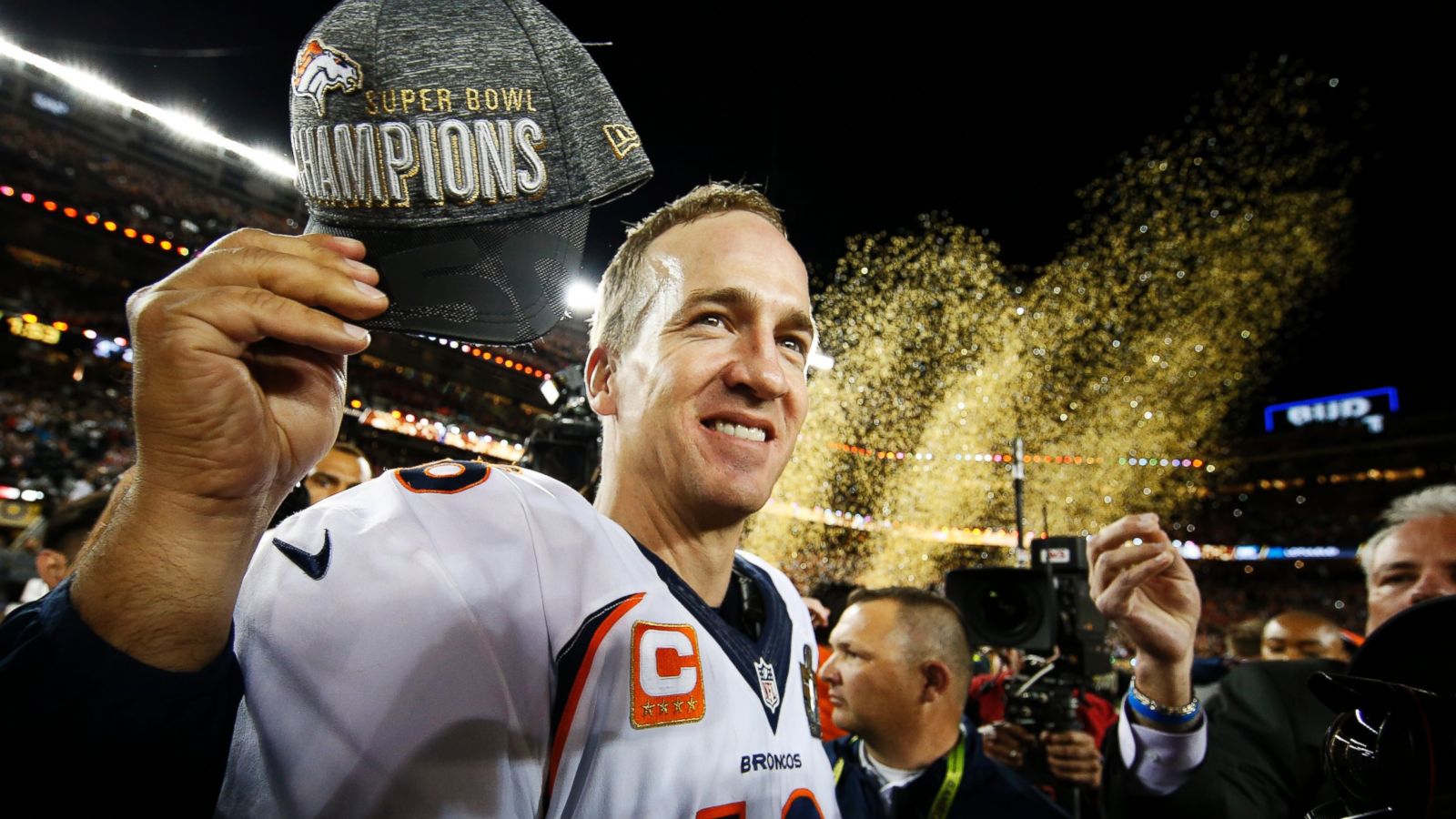 
Three losses haunted the '05 Broncos - but the '06 team made sure to leave it all the field. Champions! #FOREVER
==================
Opening Remarks
==================
The Broncos held their Championship parade earlier today, passing out "Denver C-Word" hats and t-shirts, and giving players their Super Bowl rings. While we didn't want to bury the lead (which is certainly Peyton Manning walking out of Denver as a Champion), we would be remiss if we overlooked the incredible journey to that point. Let's take a look back, picking back up just after the Manning Bowl in Week 5, which we previously covered. It's crazy that game became the one and only Manning Bowl... but what a game it was. The fun didn't stop there, however. An early BYE week (boo) provided the launch pad for a historic 2nd half of the season.
==============================
W eek Seven (6-0)
 Pittsburgh Steelers @ Denver Broncos
MADE OF STEEL: Broncos Outshine Steelers in High-Scoring Primetime Clash
DENVER – In a high-scoring All-Pro virtual matchup contested over 11-minute quarters under fair skies, 62-degree temperatures, and a light 1 mph breeze, the Denver Broncos earned a compelling 40 to 25 victory over the Pittsburgh Steelers. The contest featured an extraordinary display of big plays across all three phases of the game, including long passing strikes, a pair of 100-plus-yard kickoff return touchdowns, a 68-yard touchdown run, and a safety. Denver seized full control during the opening quarter by racing out to a 14 to 0 advantage, expanded their lead to 20 to 3 by halftime, and ultimately repelled a furious third-quarter surge from Pittsburgh. Although Pittsburgh outscored Denver 16 to 14 in a wild third quarter, Denver's ability to create explosive scoring plays proved decisive as they closed out the game to secure the 15-point victory.
Denver’s offensive rhythm was established early in the first quarter through an ultra-efficient aerial attack orchestrated by quarterback Peyton Manning. Manning finished the game completing 14 of 27 passes for 318 yards, throwing 3 touchdowns and 1 interception to achieve an impressive passer rating of 116.0 while averaging a staggering 11.78 yards per attempt. Manning’s primary target throughout the contest was wide receiver Ronnie Brown, who produced a historically dominant performance that earned him Offensive Player of the Game honors. Brown caught 5 passes for 194 yards and 3 touchdown receptions, averaging 38.8 yards per reception with a long catch of 54 yards and 38 yards after the catch. In addition to his receiving production, Brown delivered one of the game's biggest highlights on special teams when he fielded a third-quarter kickoff and returned it 101 yards for a touchdown.
The scoring opened midway through the first quarter when Peyton Manning connected with Ronnie Brown on a 27-yard touchdown pass to complete a 3-play, 81-yard drive taking 1:10 off the clock, giving Denver a 7 to 0 lead with 6:14 remaining in the opening period. Just one minute later, following a quick Pittsburgh turnover or defensive hold, Denver struck again on another 3-play drive covering 33 yards in just 17 seconds, capped by another 27-yard touchdown pass from Manning to Brown to extend the Broncos' lead to 14 to 0 with 5:13 left in the first quarter. In the second quarter, Denver extended its lead further with field goals from Josh Brown and Jeff Reed. Josh Brown converted a 19-yard field goal to conclude a 9-play, 50-yard drive with 1:58 remaining before halftime, while Jeff Reed added a 43-yard field goal after a 6-play, 56-yard march with 0:50 left in the second quarter, sending the teams to the locker rooms with Denver ahead 20 to 3.
The third quarter developed into one of the most action-packed quarters of play, generating 30 total points between the two teams in rapid succession. Denver struck first in the second half when Peyton Manning hooked up with Ronnie Brown for their third touchdown connection of the day, a 51-yard passing strike that completed a 3-play, 64-yard drive and increased Denver’s lead to 27 to 3 with 9:15 remaining in the quarter. Pittsburgh responded immediately on the very next play when Jerry Azumah fielded the kickoff and sprinted 100 yards down the sideline for a touchdown, cutting the margin to 27 to 10 with 9:03 on the clock. Moments later, Pittsburgh's star running back LaDainian Tomlinson broke loose on a 1-play drive for a stunning 68-yard touchdown run, suddenly trimming Denver's lead to 27 to 17 with 6:52 remaining in the third quarter.
However, Denver answered Pittsburgh's sudden momentum immediately on the ensuing kickoff. Ronnie Brown fielded the kick and raced 101 yards untouched into the end zone, completing a 1-play, 101-yard special teams score in just 11 seconds to push Denver's lead back out to 34 to 17 with 6:41 remaining in the third quarter. Pittsburgh managed to stay within striking distance late in the third quarter when defensive end Brandon Green tackled a Denver player in the end zone for a 0-yard safety at the 3:22 mark, pulling the Steelers to within 34 to 19 heading into the final period. In the fourth quarter, Pittsburgh attempted to mount a comeback as Jeff Reed kicked a 33-yard field goal with 7:14 left, followed by LaDainian Tomlinson scoring on a short goal-line run to finish a 12-play, 80-yard drive with 3:32 remaining. Although Pittsburgh missed the subsequent two-point conversion attempt and Reed later added a 39-yard field goal with 1:49 remaining, Denver held firm down the stretch to claim the 40 to 25 victory.
From a statistical standpoint, Denver's offensive distribution heavily featured wide receiver Marty Booker behind Ronnie Brown's explosive outing. Booker hauled in 6 receptions for 91 yards with a long of 29 yards and 16 yards after the catch. Rock Cartwright pulled in 1 catch for 18 yards, Jabar Gaffney caught 1 pass for 9 yards, and P.J. Pope contributed 1 reception for 6 yards. Denver’s ground attack was led by veteran running back Ron Dayne, who carried the ball 14 times for 74 yards, averaging 5.29 yards per carry with a long run of 23 yards. P.J. Pope added 7 rushing yards on 5 carries, Rock Cartwright logged 5 rushing yards on 2 carries, and Peyton Manning took 2 carries for negative 2 yards. Along the offensive line, Brad Meester, Daniel Graham, and Scott Wells led Denver with 4 pancake blocks each, while Dustin Rykert and Robert Gallery recorded 3 pancakes apiece.
Pittsburgh’s offensive efforts were anchored by running back LaDainian Tomlinson, who delivered a workload of 21 carries for 133 rushing yards and 2 rushing touchdowns, averaging 6.33 yards per carry. Ahmaad Galloway contributed 11 yards on 6 carries, and fullback Dan Kreider added 5 yards on 2 carries, bringing Pittsburgh's team rushing total to 149 yards on 29 carries. In the passing game, Pittsburgh quarterback Luke McCown struggled against Denver's defensive pressure, completing 15 of 32 passes for 143 yards, 0 touchdowns, and 1 interception, finishing with a 46.8 passer rating. Domenik Hixon was McCown's top receiver, catching 7 passes for 81 yards with a long of 23 yards. Randy Moss caught 2 passes for 23 yards, Eric Parker added 2 catches for 22 yards, Dan Kreider logged 1 reception for 9 yards, Mike Seidman caught 1 pass for 5 yards, Ahmaad Galloway added 1 catch for 3 yards, and Tomlinson had 1 catch for 0 yards. On Pittsburgh's offensive line, Alan Faneca turned in an exceptional performance with 10 pancake blocks, while Mike Gandy recorded 6 pancakes and Dan Kreider and Kendall Simmons added 5 pancakes each.
Defensively, Denver CB Ken Hamlin was selected as the Defensive Player of the Game after recording 5 tackles, 1 interception returned for 5 yards, and 5 pass deflections. Linebacker Al Wilson led Denver with 8 total tackles, including 1 tackle for loss, while Vincent Fuller recorded 7 tackles. Antwan Peek added 4 tackles and 1 tackle for loss, while Dexter Coakley, David Macklin, Chris Hovan, and Leroy Hill each posted 3 tackles. For Pittsburgh's defense, Brandon Green provided constant backfield penetration, recording 5 tackles, 1 tackle for loss, 2 sacks, and a safety. Boss Bailey and James Harrison each logged 5 tackles, with Harrison adding a pass deflection. Jerry Azumah recorded 4 tackles and intercepted Peyton Manning, returning the pick 3 yards. Defensive tackle Tron La Favor also brought down Manning for a sack.
Special teams play was a standout feature for both organizations throughout the afternoon. Pittsburgh's Jerry Azumah recorded 230 kickoff return yards across 7 returns, including his 100-yard touchdown sprint. Eric Parker added 19 yards on his lone kickoff return for Pittsburgh. For Denver, Ronnie Brown amassed 101 yards on his single kickoff return touchdown, while Aveion Cason returned 3 kickoffs for 97 yards with a long of 42 yards and returned 3 punts for 11 yards. Placekicker Jeff Reed was perfect for Pittsburgh, going 4-for-4 on field goal attempts and converting all four of his extra point opportunities. Josh Brown converted his only field goal attempt from 19 yards and made both of his extra point attempts for Denver. Punting duties were handled by Nick Harris for Pittsburgh, who punted 7 times for 331 yards, averaging 47.29 yards per punt with 3 punts downed inside the 20-yard line, while Brian Moorman punted once for Denver for 42 yards.
When analyzing the overall team statistics, Pittsburgh generated 12 first downs compared to Denver's 11. Pittsburgh converted 5 of 15 third-down opportunities for a 33.33% success rate, while Denver converted 3 of 10 third downs for a 30.00% rate. Pittsburgh also attempted two fourth-down conversions, converting 1 for a 50.00% conversion rate. Pittsburgh held a narrow edge in time of possession, holding the ball for 22:40 compared to Denver's 21:20. Both teams committed exactly 1 turnover on an interception, with neither team committing a fumble. Penalty discipline favored Denver, as the Broncos were flagged just 2 times for 15 yards, whereas Pittsburgh accumulated 4 penalties for 38 yards. In the end, Denver's ability to maximize explosive plays through Peyton Manning, Ronnie Brown, and special teams proved to be the decisive factor in securing their 40 to 25 victory.
==============================
W eek Eight (7-0)
 Green Bay Packers @ Denver Broncos
CHEESE GRATER: Broncos Outduel Packers in 72-Point Offense-Filled Shootout
DENVER – In an explosive, high-scoring contest played under fair skies and mild 60-degree weather with virtually no wind at 1 mph, the Denver Broncos emerged victorious over the Green Bay Packers by a score of 40 to 32. The matchup featured a relentless offensive showcase from both sidelines, combining for 72 total points and nearly 900 yards of combined total offense. Denver established early control of the game behind a dominant first-half aerial assault led by quarterback Peyton Manning, taking a 10 to 0 lead in the first quarter and extending their margin to 27 to 10 by halftime. Green Bay fought back vigorously in the second half, relying on deep passing strikes and special teams highlights to stay competitive, including a 98-yard kickoff return touchdown by Marcel Shipp and an 82-yard touchdown pass from Dave Ragone to Donald Driver late in the fourth quarter. Despite Green Bay's desperate 15-point fourth-quarter rally, Denver's high-octane passing offense and consistent placekicking proved too much to overcome, securing the eight-point win for the home team.
The quarterback play across both rosters defined the character and speed of the contest. Denver’s primary passer, Peyton Manning, put on a masterclass efficiency show during his time on the field, completing 13 of 18 pass attempts for 339 yards, 3 touchdowns, and 0 interceptions, finishing with a near-perfect passer rating of 153.9 and an eye-popping average of 18.83 yards per pass attempt. Quarterback Drew Bledsoe also saw action under center for Denver, adding 4 completions on 7 attempts for 102 yards, 1 touchdown, and 1 interception to achieve a 101.8 rating. Combined, Denver’s passing game racked up 438 total passing yards with an extraordinary 17.52 yards per completion. For the Packers, quarterback Dave Ragone carried the weight of the offense on 43 pass attempts, completing 23 passes for 370 yards, 2 touchdowns, and 1 interception. Ragone also added a rushing touchdown, though he was harassed by the Denver pass rush throughout the afternoon, taking 6 sacks and finishing with an 88.3 passer rating.
Green Bay wide receiver Donald Driver and Denver quarterback Dave Ragone earned top player honors, with Ragone named Offensive Player of the Game with 23 points and Packers middle linebacker Jonathan Goddard named Defensive Player of the Game with 25 points. Driver produced the single most dynamic receiving display of the day, catching 6 passes for 150 yards and 2 touchdowns, including an 82-yard scoring strike in the fourth quarter. Hines Ward was equally vital for Green Bay’s move-the-chains strategy, pulling down 7 receptions for 127 yards with 30 yards coming after the catch. Tight end Bubba Franks added 4 receptions for 44 yards, Ahman Green recorded 2 catches for 23 yards, LenDale White had 1 catch for 10 yards, Jameel Cook logged 2 receptions for 8 yards, and Craig Bragg caught 1 pass for 8 yards.
Denver’s pass-catching corps benefited from huge gains downfield, led by wide receiver Ronnie Brown, who caught 6 passes for 121 yards. Tight end Adam Bergen made immense contributions on limited touches, catching 3 passes for 104 yards, headlined by a magnificent 76-yard touchdown catch in the third quarter. Marty Booker was lethal in the red zone and deep, hauling in 3 receptions for 77 yards and 2 touchdown catches. Tight end Daniel Graham made the first major splash of the game on a 75-yard touchdown catch, while Jabar Gaffney caught 2 passes for 64 yards. P.J. Pope caught 1 pass for 2 yards, while Rock Cartwright had 1 catch for negative 2 yards.
The running game played a supporting role relative to the passing aerials, but both teams relied on their backs to manage momentum. Denver grounded out 88 rushing yards on 33 carries, led by Ron Dayne, who shouldered the bulk of the workload with 26 carries for 74 yards. Backup P.J. Pope added 17 yards on 4 carries, while Drew Bledsoe finished with negative 3 yards on 3 attempts. Green Bay was held to just 46 rushing yards on 13 carries as they played behind for most of the game. Ahman Green led the Packers with 10 carries for 33 yards, LenDale White had 1 carry for 9 yards, and Dave Ragone ran 2 times for 4 yards and a short touchdown.
The scoring action got underway in the first quarter when Denver opened with a explosive 3-play, 80-yard drive that took just 1:26 off the clock. Peyton Manning found Daniel Graham wide open for a 75-yard touchdown pass to make it 7 to 0 with 9:34 left in the quarter. Denver padded its early lead with a 33-yard field goal from Jeff Reed to complete a 5-play, 69-yard drive with 6:16 left in the first period, building a 10 to 0 margin. Green Bay answered early in the second quarter with an 11-play, 80-yard march that consumed 4:33, resulting in a 46-yard field goal by Shayne Graham to make the score 10 to 3 with 8:18 remaining before halftime.
Denver exploded mid-way through the second quarter with back-to-back touchdown drives. First, Manning completed a 61-yard touchdown pass to Marty Booker on a 4-play, 79-yard drive taking 2:00, expanding the lead to 17 to 3 at the 6:18 mark. Shortly after, Manning and Booker connected again for a 6-yard touchdown pass to top off a 5-play, 60-yard drive, making the score 24 to 3 with 3:28 left in the half. Green Bay generated momentum before the break when Dave Ragone hit Donald Driver for a 7-yard touchdown pass, capping a 7-play, 77-yard drive with 1:36 remaining. However, Denver quickly answered with a 6-play, 72-yard drive in 53 seconds, setting up a 24-yard Jeff Reed field goal with 0:43 left to give Denver a 27 to 10 halftime lead.
The third quarter saw Jeff Reed extend Denver's lead to 30 to 10 with a 54-yard field goal with 7:20 remaining. Green Bay immediately responded when Marcel Shipp fielded the kickoff and raced 98 yards down the field for a kickoff return touchdown, trimming the deficit to 30 to 17 with 7:09 on the clock. Denver struck back through Drew Bledsoe, who threw a 76-yard touchdown pass to Adam Bergen on a 3-play, 84-yard drive to push Denver's lead back out to 37 to 17 with 3:10 remaining in the third period.
In the fourth quarter, Green Bay attempted a spirited comeback. Dave Ragone scored on a short 0-yard touchdown run to complete a 5-play, 53-yard drive with 3:16 left, bringing the score to 37 to 24. Denver's Jeff Reed answered with his fourth field goal of the game, a 51-yarder with 1:53 left, making it 40 to 24. On the following drive, Ragone hit Donald Driver for an 82-yard touchdown pass, and Green Bay converted the two-point conversion to narrow the gap to 40 to 32 with 1:26 remaining. However, Denver successfully closed out the final seconds to wrap up the 40 to 32 win.
Defensively, Packers middle linebacker Jonathan Goddard earned Defensive Player of the Game after compiling 8 tackles (3 for loss), 1 fumble recovery, 1 interception with a 1-yard return, and 3 pass deflections. Mike Adams and Julian Peterson each recorded 6 tackles for Green Bay, while Sean Smith and Gerris Wilkinson each logged 5 tackles. Green Bay's defense also recorded a sack from D.J. Williams. Denver’s defense featured a relentless pass rush that generated 6 total sacks against Ragone. Defensive end Victor Adeyanju and defensive tackle Matt Walters recorded 2 sacks each, while Tamba Hali and DeMario Minter contributed 1 sack apiece. Linebacker Al Wilson, safety Hanik Milligan, and cornerback Stanford Routt led Denver with 5 tackles each, with Ken Hamlin adding an interception and Stanford Routt recovering a fumble.
Special teams plays were prominent throughout the matchup. Green Bay's Brandon Jones returned 6 kickoffs for 141 yards, while Marcel Shipp added 122 yards on 2 kickoff returns, including his 98-yard touchdown return. Shipp also returned 2 punts for 19 yards. For Denver, Aveion Cason returned 2 kickoffs for 46 yards and 3 punts for 4 yards. Kicker Jeff Reed had an outstanding game for Denver, going 4-for-4 on field goals with conversions from 33, 24, 54, and 51 yards, alongside 4 extra points. Shayne Graham hit his single field goal attempt from 46 yards and made all 3 of his extra points for Green Bay. Punting was handled by Filip Filipovic for Green Bay (5 punts for 201 yards, 40.2 average) and Brian Moorman for Denver (4 punts for 200 yards, 50.0 average).
In total team statistics, Green Bay earned 15 first downs compared to Denver's 11. Green Bay converted 6 of 14 third downs (42.86%), while Denver converted 4 of 13 third downs (30.77%). Green Bay held a slight edge in total plays, but Denver dominated overall yards with 526 total yards of offense compared to Green Bay's 385. Denver won the time of possession battle with 23:15 to Green Bay's 20:45. Turnovers were crucial, as Green Bay committed 2 turnovers (1 interception, 1 fumble lost), while Denver committed 1 turnover on an interception. Both teams were disciplined, with Green Bay called for 1 penalty for 5 yards and Denver penalized 2 times for 15 yards. Ultimately, Denver's explosive vertical passing game and flawless placekicking made the difference in their 40 to 32 victory over Green Bay.
==============================
W eek Nine (8-0)
Denver Broncos @ Detroit Lions 
A SUPER PREVIEW: Broncos Edge Lions in Physical Defensive Grind
DETROIT – In a hard-fought, defensive battle played under fair weather conditions, 79-degree temperatures, and calm winds at 0 mph, the Denver Broncos earned a tough 22 to 17 road victory over the Detroit Lions. The game was defined by methodical clock-chewing drives, strong red-zone defense, and key field goals from Denver placekicker Jeff Reed. Denver jumped out to an early 16 to 7 lead in the first half and successfully fended off Detroit's fourth-quarter comeback bid. Despite Detroit racking up 419 total yards of offense compared to Denver's 352, the Broncos' efficiency inside the red zone—converting all four of their opportunities into points—proved to be the deciding factor in securing the five-point victory.
Under center for Denver, quarterback Drew Bledsoe executed a composed passing effort against Detroit's secondary, completing 15 of 28 passes for 235 yards, 1 touchdown, and 1 interception to post a passer rating of 78.7 with an average of 8.39 yards per attempt. His primary targets downfield were tight end Daniel Graham, who caught 4 passes for 78 yards (including a long gain of 40 yards), and Jabar Gaffney, who hauled in 3 receptions for 50 yards with a long of 29 yards. Tight end Adam Bergen caught 2 passes for 41 yards, David Martin recorded 2 catches for 30 yards and a critical fourth-quarter touchdown, Ronnie Brown caught 2 passes for 16 yards, and Marty Booker added 2 receptions for 10 yards.
For Detroit, quarterback Donovan McNabb spearheaded an explosive deep-passing attack that kept the Lions within striking distance throughout the game. McNabb completed 16 of 37 pass attempts for 316 yards, 1 touchdown, and 0 interceptions, generating a passer rating of 82.7. McNabb's top performer was wide receiver Anquan Boldin, who earned Offensive Player of the Game honors with a stellar 4-catch, 141-yard performance that included a 67-yard touchdown reception in the second quarter. Star tight end Antonio Gates was equally impactful, catching 4 passes for 96 yards with a long play of 41 yards. Muhsin Muhammad added 2 catches for 30 yards, Scotty Anderson hauled in 3 receptions for 27 yards, Desmond Clark had 1 catch for 10 yards, Doug Jolley recorded 1 catch for 6 yards, and Chase Lyman caught 1 pass for 6 yards.
On the ground, Denver relied heavily on veteran running back Ron Dayne to establish physical dominance and control the clock. Dayne rushed 22 times for 100 yards, averaging 4.55 yards per carry with a long run of 13 yards. Backup running back P.J. Pope added 21 rushing yards on 8 carries, including a 2-yard touchdown run, while Rock Cartwright had 1 carry for 2 yards and Drew Bledsoe had 1 rush for negative 1 yard. In total, Denver produced 122 rushing yards on 32 carries. Detroit countered with 103 rushing yards on 26 carries, led by Kevan Barlow's 70 yards on 19 carries. Power back Brandon Jacobs contributed 27 yards on 5 carries, capped by a 1-yard touchdown run in the fourth quarter, while Doug Jolley added 6 yards on 2 carries.
The game kicked off with Denver asserting early offensive control. The Broncos opened the scoring in the first quarter when Jeff Reed capped off an 11-play, 69-yard drive taking 5:35 with a 19-yard field goal to give Denver a 3 to 0 lead with 2:13 left in the period. In the second quarter, Denver extended its advantage on an 8-play, 57-yard drive that ended with a 2-yard touchdown rush by P.J. Pope, making the score 10 to 0 with 8:23 remaining before halftime. Detroit quickly answered back just 41 seconds later when Donovan McNabb launched a 67-yard touchdown pass to Anquan Boldin, finishing a 2-play, 76-yard strike to trim Denver's lead to 10 to 7 with 7:42 left in the quarter.
Denver responded to Detroit's big play with two consecutive field goals before halftime. Jeff Reed drilled a 51-yard field goal to wrap up a 7-play, 75-yard drive with 5:49 left, and then added a 20-yard field goal following a 12-play, 80-yard drive with 0:41 left, sending the teams to the locker room with Denver leading 16 to 7. After a scoreless third quarter dominated by defensive stops, Detroit opened the fourth quarter with a 10-play, 80-yard drive capped by a 50-yard field goal from Matt Leach, pulling the Lions to within 16 to 10 with 10:53 remaining in the contest.
Denver answered Detroit's fourth-quarter field goal with a decisive touchdown drive. Bledsoe guided the Broncos on a 6-play, 69-yard march that culminated in a 9-yard touchdown pass to David Martin with 8:54 remaining. Although the subsequent two-point conversion attempt failed, Denver pushed its lead to 22 to 10. Detroit refused to go quietly, responding on their next possession with a 6-play, 69-yard drive capped by Brandon Jacobs's 1-yard touchdown plunge to cut the deficit to 22 to 17 with 6:36 remaining. However, Denver's defense held firm on Detroit's final possessions to secure the 22 to 17 victory.
Defensively, Detroit free safety Jon McGraw was named Defensive Player of the Game, recording 5 tackles (1 for loss), 1 interception returned for 2 yards, and 1 pass deflection. Linebacker Chris Claiborne led the Lions with 6 tackles, while Bruce Thornton, Sean Taylor, and Michael Boley each logged 5 tackles. Aaron Smith recorded 4 tackles and registered Detroit's only sack of the day against Drew Bledsoe. Defensive back Donnie Edwards also had 4 tackles and a pass deflection.
Denver's defensive effort was anchored by linebacker Al Wilson, who recorded a game-high 8 tackles, including 1 tackle for loss. Hanik Milligan, Chris Hovan, and Antwan Peek each logged 5 tackles for the Broncos, with Peek and Hovan recording 1 tackle for loss apiece. Defensive back Ken Hamlin, cornerback Shawn Springs, and linebacker Leroy Hill each posted 4 tackles. Denver's coverage unit was active throughout the game, with Hanik Milligan deflecting 3 passes, while Leroy Hill, Antwan Peek, Charlie Anderson, Ko Simpson, and Stanford Routt each recorded a pass deflection.
Special teams play was consistent on both sides. For Denver, Aveion Cason returned 4 kickoffs for 101 yards (25.25 average) with a long return of 30 yards, and added 1 punt return for 6 yards. For Detroit, Eddie Drummond returned 6 kickoffs for 136 yards (22.67 average) with a long return of 29 yards. Denver placekicker Jeff Reed was flawless, converting all 3 of his field goal attempts (19, 51, and 20 yards) and making his only extra point attempt. Matt Leach hit his single 50-yard field goal attempt and converted both extra points for Detroit. Punting was handled by Brian Moorman for Denver (3 punts for 146 yards, 48.67 average, long of 56) and Jason Baker for Detroit (4 punts for 164 yards, 41.00 average, long of 55).
On the offensive lines, Willie Roaf produced a dominant blocking performance for Denver, recording 10 pancake blocks without allowing a sack. Daniel Graham, Rock Cartwright, and Dustin Rykert each recorded 4 pancake blocks for Denver, while Brad Meester and Scott Wells added 3 pancakes each. For Detroit, Doug Jolley, George Foster, and Tony Pashos led the way with 4 pancake blocks apiece, while Enoch DeMar and Claude Terrell contributed 3 pancakes each.
In the final statistical summary, Denver logged 17 first downs to Detroit's 15. Denver was highly effective on third downs, converting 7 of 13 attempts (53.85%), while Detroit converted 5 of 14 third downs (35.71%). Detroit was aggressive on fourth down, converting 2 of 4 attempts (50.00%). Denver maintained a slight edge in time of possession at 22:33 compared to Detroit's 21:27. Denver committed 1 turnover on an interception, while Detroit played turnover-free football. Both teams exhibited clean play, as Denver was penalized 1 time for 5 yards and Detroit was flagged 1 time for 10 yards. Ultimately, Denver's superior red-zone execution and strong running game allowed them to claim the 22 to 17 victory.
==============================
W eek Ten (9-0)
Denver Broncos @ Kansas City Chiefs
ROAD WARRIORS: Broncos Outlast Chiefs in 76-Point High-Plains Thriller
KANSAS CITY – In a high-scoring divisional showdown played under cool 53-degree, windy conditions, the Denver Broncos prevailed over the Kansas City Chiefs by a score of 43 to 33. The contest featured an extraordinary display of offensive playmaking, dynamic special teams scoring opportunities, and constant defensive turnover pressure, resulting in 76 total points. Denver established early momentum by taking a 14 to 0 lead in the first quarter, before Kansas City fought back in a wildly entertaining second period that saw the two teams combine for 29 points and head to halftime tied at 24 to 24. Denver regained control in the second half behind a powerful ground game and automatic placekicking from Jeff Reed, outscoring Kansas City 17 to 7 in the third quarter and holding on through a tense fourth quarter. Ultimately, Denver's ability to capitalize on five Chiefs turnovers proved to be the deciding factor in securing the 10-point road victory.
The quarterback duel highlighted contrasting offensive styles, with Peyton Manning managing a balanced, hyper-efficient Denver attack while Byron Leftwich generated massive gains downfield for Kansas City. Manning completed 14 of 22 pass attempts for 182 yards, throwing 2 touchdown passes and 1 interception to finish with a solid 100.9 passer rating. Manning's calculated distribution targeted tight windows and red-zone opportunities, averaging 8.27 yards per pass attempt. On the opposite sideline, Byron Leftwich delivered a massive statistical outing despite constant backfield pressure, completing 20 of 35 passes for 400 yards, 2 touchdowns, and 3 interceptions for an 80.6 rating. Leftwich averaged an astounding 11.43 yards per attempt, frequently connecting on deep routes, but was brought down for 6 sacks by a relentless Denver pass rush.
Individual player honors were awarded to Chiefs wide receiver Albert Johnson, who earned Offensive Player of the Game with 16 points, and Broncos outside linebacker Antwan Peek, who earned Defensive Player of the Game with 25 points. Johnson was dynamic for Kansas City, hauling in 5 receptions for 132 yards and a touchdown, including a long catch of 48 yards, while adding 172 kick return yards across 7 attempts. Peek was the cornerstone of Denver's disruptive defensive effort, recording 9 tackles (1 for loss), 2 sacks, 1 fumble recovery, and 2 pass deflections to spearhead a unit that forced 5 total turnovers.
Denver’s rushing attack served as the foundation of their second-half success, accumulating 213 yards on 30 carries for a 7.10 yards-per-carry average. Veteran running back Ron Dayne produced a dominant performance, carrying the ball 19 times for 140 rushing yards, highlighted by a game-breaking 43-yard touchdown run in the third quarter. Speedster P.J. Pope provided high-efficiency relief, racking up 74 yards and a touchdown on just 6 carries, averaging 12.33 yards per rush with a long gain of 58 yards. Rock Cartwright added 1 yard on 3 carries, while Peyton Manning lost 2 yards on 2 kneel-downs. Kansas City countered with 106 yards on 30 attempts, led by Travis Henry, who logged 82 yards and 1 rushing touchdown on 19 carries while catching a 22-yard touchdown pass. Cedric Benson added 23 yards and a touchdown on 10 carries, and Leftwich scrambled once for 1 yard.
The game opened with Denver striking quickly following an early turnover. Peyton Manning capitalized on short field position by finding Ronnie Brown for a 7-yard touchdown pass, capping a 3-play, 18-yard drive to give Denver a 7 to 0 lead with 7:11 left in the first quarter. Kansas City answered on their subsequent possession as Byron Leftwich guided an 80-yard drive in 6 plays, finding Travis Henry for a 22-yard touchdown strike to knot the score at 7 to 7 with 4:52 remaining. Jeff Reed then put Denver back ahead with a 28-yard field goal with 2:17 left in the period, concluding a brief 3-play, 17-yard drive. However, Kansas City struck right back on the very next play from scrimmage when Leftwich launched an 80-yard touchdown bomb to Rasheed Marshall, putting the Chiefs up 14 to 10 with 2:07 left in the opening frame.
The second quarter brought relentless scoring swings between the two rivals. Kansas City extended its lead to 17 to 10 at the 4:16 mark when kicker Jay Feely drilled a 45-yard field goal to wrap up a 6-play, 65-yard drive. Denver responded with an extended 11-play, 80-yard march taking 2:40, capped by Manning finding Marty Booker in the back of the end zone for a 4-yard touchdown pass to tie the game at 17 with 1:36 left before halftime. Denver's defense then forced a quick takeaway, allowing Manning to orchestrate a rapid 6-play, 72-yard drive that ended with a 9-yard touchdown pass to Sinorice Moss with just 23 seconds left, pushing Denver ahead 24 to 17. Unwilling to go into halftime trailing, Kansas City executed a stunning 2-play, 61-yard drill in 18 seconds, culminating in a 13-yard touchdown pass from Leftwich to Alge Crumpler with 5 seconds on the clock to tie the game at 24 at the break.
Denver exerted its dominance in the third quarter by controlling the line of scrimmage. On their opening drive of the second half, Ron Dayne broke free for a 43-yard touchdown run to complete an 8-play, 80-yard drive, putting Denver ahead 31 to 24 with 8:29 remaining in the quarter. Kansas City trimmed the deficit to 31 to 27 when Jay Feely hit a 32-yard field goal following a 10-play, 69-yard drive with 3:55 left in the third. In the fourth quarter, Feely added a 38-yard field goal with 8:04 remaining to bring the Chiefs within one point at 31 to 30. However, Denver's offense responded with poise, as Jeff Reed connected on a 23-yard field goal with 4:53 left and a clutch 49-yard field goal with 1:05 remaining to stretch the lead to 37 to 30. Late defensive heroics, including a defensive scoop-and-score touchdown return by Leroy Hill, sealed the 43 to 33 victory for Denver.
Through the air, Marty Booker was Manning's primary deep threat for Denver, catching 5 passes for 120 yards with a long of 47 yards and 28 yards after the catch. Ronnie Brown served as a reliable outlet, catching 6 passes for 42 yards and a touchdown. Tight end Daniel Graham caught 2 passes for 11 yards, while David Martin made the most of his single reception, turning it into a 9-yard touchdown catch. Kansas City's receiving corps saw huge production across the board behind Albert Johnson's 132-yard day. Rasheed Marshall hauled in 5 receptions for 104 yards, including his 80-yard touchdown catch. Tight end Kris Wilson caught 2 passes for 51 yards, Cedric Benson logged 1 catch for 44 yards, Marcus Maxwell had 3 catches for 43 yards and a touchdown, Samie Parker caught 1 pass for 9 yards, Alge Crumpler recorded 1 catch for 8 yards, Kwame Harris had 1 catch for 8 yards, and Arnold Jackson gained 1 yard on 1 catch.
Along the offensive line, Denver generated tremendous push for their rushing attack. Dustin Rykert led all blockers with an impressive 11 pancake blocks, while Willie Roaf recorded 7 pancakes without allowing a sack. Rock Cartwright and Robert Gallery each added 6 pancake blocks, Scott Wells had 5, Daniel Graham recorded 4, and Brad Meester logged 3. For Kansas City, Kevin Boothe recorded 4 pancake blocks, while Mo Collins, Keydrick Vincent, and Alex Stepanovich logged 3 pancakes each. However, Kansas City's line struggled in pass protection, allowing 6 sacks on Leftwich, including 3 allowed by Tyson Clabo and 2 by Mo Collins.
Denver’s defensive unit delivered a game-altering performance by constantly harassing Leftwich and forcing critical errors. Defensive tackle Matt Walters was a major force in the trenches, collecting 7 tackles (1 for loss), 3 sacks, and 1 fumble recovery. Safety Hanik Milligan recorded 9 tackles, 1 sack, and 1 pass deflection, while linebacker Leroy Hill contributed 7 tackles and scored a touchdown on a 27-yard fumble recovery return. Cornerback Vincent Fuller logged 5 tackles and a deflection, while safety Ken Hamlin made 4 tackles, 1 interception, and 2 pass deflections. Al Wilson, Tamba Hali, and David Macklin each contributed to the turnover tally, with Macklin recording an interception returned for 10 yards and Wilson recovering a fumble.
Kansas City’s defense was led by linebacker Kendrell Bell, who recorded 6 tackles (1 for loss). D'Qwell Jackson, Clint Ingram, and James Sanders each logged 5 tackles. Ingram also recorded 1 sack and intercepted Manning, returning it 8 yards. Etric Pruitt, Corey Webster, Charles Tillman, and Jimmy Williams each recorded 4 tackles for the Chiefs. Cornerback Shawn Springs also picked off a Manning pass, returning it 1 yard.
Special teams execution heavily favored Denver's placekicking while Kansas City gained an advantage on kick returns. Denver kicker Jeff Reed was a perfect 5-for-5 on field goal attempts, converting from 28, 23, and 49 yards alongside two other attempts, while converting all 4 of his extra point opportunities. Jay Feely was also perfect for Kansas City, converting field goals of 45, 32, and 38 yards along with 3 extra points. In the return game, Albert Johnson produced 172 yards on 7 kickoff returns for Kansas City, while Aveion Cason returned 5 kickoffs for 114 yards for Denver. Punting duties were handled by Brian Moorman for Denver (3 punts for 138 yards, 46.0 average) and Travis Dorsch for Kansas City (1 punt for 44 yards).
In overall team statistics, Kansas City generated 19 first downs to Denver's 14, outgaining the Broncos 480 total yards to 391. However, third-down execution was low for both squads, as Denver converted 2 of 10 third downs (20.00%) and Kansas City converted 3 of 11 (27.27%). Kansas City was aggressive on fourth down, converting 2 of 3 attempts (66.67%). Both teams executed well in the red zone, with Kansas City scoring on all 5 of their red-zone appearances (100.00%) and Denver scoring on 3 of 5 (60.00%). Kansas City held a slight edge in time of possession at 22:52 to Denver's 20:56. Penalty discipline was identical, as both teams were flagged 2 times for 20 yards. Ultimately, the turnover battle decided the outcome: Kansas City committed 5 costly turnovers (3 interceptions, 2 fumbles lost), while Denver turned the ball over just once, paving the way for the Broncos' 43 to 33 triumph.
==============================
W eek Eleven (10-0)
 Tennessee Titans @ Denver Broncos
SINKING THE TITAN-IC: Broncos Stifle Titans in Dominant 30-3 Defensive Masterclass
DENVER – In a crisp, 50-degree afternoon battle played under fair skies and calm winds, the Denver Broncos put on a defensive masterclass, suffocating the Tennessee Titans 30 to 3. Denver controlled the game across all four quarters, converting key third downs and pairing an explosive running game with clutch downfield passing from quarterback Peyton Manning. Tennessee briefly kept pace in the first quarter with a field goal to make it 7 to 3, but Denver’s defense completely locked down the Titans thereafter, shutting them out across the final three quarters. Outgaining Tennessee 398 total yards to 242 and winning the time of possession battle by over seven minutes, Denver delivered a polished, complete team performance from start to finish.
Peyton Manning managed the game with supreme poise under center for Denver, completing 14 of 33 passes for 218 yards, 2 touchdowns, and 0 interceptions to earn an 85.2 passer rating. Though his completion percentage hovered at 42.4%, Manning consistently attacked Tennessee downfield when opportunities presented themselves, averaging 6.61 yards per attempt and striking for key touchdown plays of 52 and 22 yards. For Tennessee, quarterback Daunte Culpepper struggled to find consistent rhythm against Denver’s aggressive secondary. Culpepper finished 13 of 25 passing for 132 yards, 0 touchdowns, and 1 interception, while absorbing 2 sacks and finishing with a passer rating of 50.8.
Individual game honors were claimed by Denver's stars on both sides of the ball. Running back Ronnie Brown earned Offensive Player of the Game honors with a 15-point performance, serving as Manning’s primary receiving target out of the backfield with 7 receptions for 135 yards and a 52-yard touchdown catch. On defense, safety Ken Hamlin was named Defensive Player of the Game with 17 points, recording 6 tackles, 4 pass deflections, and a game-sealing 36-yard interception return.
Denver’s ground game was fueled by dynamic running back Ron Dayne, who ripped through Tennessee’s front seven for 138 rushing yards on just 14 carries, averaging an incredible 9.86 yards per rush with a long run of 47 yards. Backup running back P.J. Pope added 42 yards on 11 carries, including a 3-yard touchdown rush in the fourth quarter. Rock Cartwright chipped in 10 yards on 2 carries, while Peyton Manning logged 2 rushes for negative 5 yards on late-game kneel-downs. In total, Denver racked up 185 rushing yards on 29 attempts (6.38 average). Tennessee produced 121 yards on 24 carries, led by veteran Fred Taylor's 97 yards on 21 carries (4.62 average). Jonathan Wells added 14 yards on 2 carries, and Josh Scobey had 1 carry for 10 yards.
Denver established control early in the opening quarter. Following a defensive stop, Peyton Manning capped a 5-play, 70-yard drive by connecting with Ronnie Brown for a breathtaking 52-yard touchdown pass, putting Denver up 7 to 0 with 5:25 remaining in the first quarter. Tennessee answered with its only scoring drive of the contest, as Daunte Culpepper engineered a 10-play, 81-yard march over 5:18, culminating in a 20-yard field goal by Mark Jensen to cut the lead to 7 to 3 with 0:07 left in the opening period.
From that point forward, Denver’s defense took total command while the offense steadily expanded the lead. In the second quarter, placekicker Jeff Reed completed a 10-play, 71-yard drive with a 25-yard field goal, sending Denver into the locker room with a 10 to 3 halftime advantage at the 8:33 mark. Coming out of halftime, Denver extended its lead on a 5-play, 86-yard drive when Manning struck Jabar Gaffney for a 22-yard touchdown pass with 7:12 left in the third quarter, extending the lead to 17 to 3. Jeff Reed then added a 44-yard field goal late in the third quarter following a 6-play, 73-yard drive to make it 20 to 3 heading into the final frame.
Denver put the game out of reach in the fourth quarter. P.J. Pope capped a 9-play, 44-yard drive with a 3-yard touchdown plunge to increase the score to 27 to 3 with 6:46 remaining. Jeff Reed then put the final punctuation mark on the victory by drilling a 42-yard field goal with 1:50 left in the game, wrapping up a 7-play, 50-yard march and securing the 30 to 3 win.
In the receiving corps, Ronnie Brown dominated Denver's target share with his 135-yard touchdown performance. Veteran Marty Booker caught 3 passes for 27 yards, while Ron Dayne hauled in 1 catch for 25 yards out of the backfield. Wideout Jabar Gaffney caught 1 pass for a 22-yard touchdown, and tight end Daniel Graham added 2 receptions for 9 yards. For Tennessee, David Boston led all receivers with 3 catches for 52 yards (long of 21), while Michael Jenkins caught 3 passes for 24 yards. Fred Taylor added 2 receptions for 21 yards, Tyrone Calico had 2 catches for 12 yards, Richard Angulo caught 2 passes for 12 yards, and Joel Dreessen added 1 reception for 11 yards.
Denver's offensive line surrendered just 1 sack while opening massive holes in the run game. Left tackle Willie Roaf and right tackle Dustin Rykert led the charge with 5 pancake blocks each. Brad Meester recorded 4 pancakes, Scott Wells logged 3, Rock Cartwright added 2, and Marty Booker, David Martin, Daniel Graham, and Robert Gallery added 1 pancake block apiece. Tennessee's blocking unit was led by Ephraim Salaam with 8 pancake blocks, Joel Dreessen with 6, and Willie Anderson and Makoa Freitas with 5 each. However, Tennessee allowed 2 sacks on Culpepper, including 1 allowed by Anderson.
Denver’s defensive front and secondary put on an elite display. Middle linebacker Al Wilson anchored the unit with a game-high 8 tackles. Defensive back Ken Hamlin logged 6 tackles, 4 pass deflections, and 1 interception returned for 36 yards. Vincent Fuller recorded 6 tackles, while Antwan Peek added 5 tackles (1 for loss) and 1 deflection. Hanik Milligan and Stanford Routt each logged 4 tackles. Up front, defensive linemen Mike Rucker and Matt Walters each recorded a sack on Culpepper, with Rucker recording 3 tackles and Walters adding 2.
Tennessee's defensive effort was paced by safeties Terrence Holt and Tank Williams, who recorded 7 tackles apiece. Holt also recovered a Denver fumble, while Williams logged 1 tackle for loss and 2 pass deflections. Linebacker Solomon Bates recorded 5 tackles (1 for loss), while cornerbacks Samari Rolle and Lenny Walls each logged 4 tackles and 2 pass deflections. Defensive end Jevon Kearse had 4 tackles, and defensive tackle Dan Wilkinson recorded 2 tackles and Tennessee's lone sack on Peyton Manning.
Special teams play was exceptional for Denver. Kicker Jeff Reed was flawless, converting all 3 of his field goal attempts (25, 44, and 42 yards) and making all 3 extra point attempts. Tennessee kicker Mark Jensen hit his only field goal attempt from 20 yards. Returner Aveion Cason brought back 2 kickoffs for 58 yards (29.0 average) and added 3 punt returns for 20 yards for Denver. Tennessee's Josh Scobey had a busy day on returns, returning 7 kickoffs for 158 yards (22.57 average) and 1 punt for 6 yards. Punter Brian Moorman averaged 47.25 yards on 4 punts for Denver (long of 53), while Kevin Stemke averaged 44.71 yards on 7 punts for Tennessee (long of 57).
In the final statistical summary, Denver earned 16 first downs to Tennessee's 13. Denver excelled on third down, converting 9 of 16 attempts (56.25%), while Tennessee struggled immensely, converting just 1 of 10 third-down attempts (10.00%). Denver was a perfect 3-for-3 in red-zone scoring opportunities (1 touchdown, 2 field goals), while Tennessee scored on its sole red-zone trip (1 field goal). Denver controlled the clock, holding the ball for 25:45 compared to Tennessee's 18:15. Denver played clean football without committing a turnover, while Tennessee's single turnover came on Hamlin's fourth-quarter interception. Discipline was high on both sides, as Tennessee committed 0 penalties and Denver was penalized 3 times for 25 yards. Ultimately, Denver's relentless defense and balanced offensive production sealed a convincing 30 to 3 win. |
|
Forum Discussion
(by A_Fernandez on 08/11/2026)
|
Replies - 0 :: Views - 14 |
|
The Denver C-Words |
CHAMPIONS: The Denver Broncos Win Super Bowl XLI GM Anthony Fernandez completes the second (18-1) Super Bowl season of his Madden Career. Champion-y? by Woody Paige, Mile High Report
in association with the Denver Gazette
August 11th, 2007

"Dread it. Run from it. Destiny arrives all the same. And now, it's here. Or should I say... I am." - Thanos
==============================
Super Bowl W eek (18-1)
Detroit Lions @ Denver Broncos
| SBXLI | Q1 | Q2 | Q3 | Q4 | OT | FINAL |
|---|
 | 2 | 14 | 0 | 13 | 0 | 29 |  | 14 | 10 | 7 | 3 | 0 | 34 |
PLAYER OF THE GAME
QB Peyton Manning (18/31 | 301 Yards | 58.1% | 4 TD | 1 INT | 117.1 QBR | 1 SACK)
Super Bowl XLI:
AF and QB Peyton Manning navigate the pressure and become Champions (again).
Super Bowl XLI delivered an unforgettable, high-stakes battle between the Detroit Lions and the Denver Broncos, culminating in a 34–29 victory for Denver under fair skies and mild 46-degree weather. The game showcased a thrilling contrast in styles, pitting Detroit's explosive aerial chunk plays against Denver's disciplined, balanced, and time-consuming offensive machine. By the end of four grueling quarters, the Broncos managed to control the line of scrimmage, win the crucial turnover battle, and lean on their superstars to capture the championship trophy. The early stages of the contest saw Denver set a dominant tone, surging out to a 14–2 lead in the first quarter. The Lions managed to get on the board via an early safety, but Denver’s high-octane offense quickly took over. Peyton Manning was razor-sharp early on, orchestrating the offense with surgical precision and taking advantage of Detroit's defensive aggressive posturing. Manning found his primary playmakers in rhythm, distributing the ball to stretch the field both horizontally and vertically. Detroit struggled to find an early rhythm, bogged down by quick possessions and defensive penalties that sustained Denver drives. In the second quarter, Detroit found its footing and fought back with a vengeance, outscoring Denver 14–10 in a chaotic frame. Lions quarterback Doug Johnson began dialing up deep shots to his dangerous receiving corps, taking full advantage of single coverage down the field. Detroit punched in two touchdowns during the quarter, exploiting lapses in the Denver secondary. However, Denver answered back with timely scoring drives of their own, including a field goal from Jeff Reed and another touchdown drive engineered by Manning, allowing the Broncos to hold a 24–16 lead going into the halftime locker room. Coming out of the break, Denver tightened its grip on the contest during the third quarter. The Broncos defense pitched a shutout in the period, holding the Lions to zero points through physical secondary play and disciplined run containment.
Offensively, Denver added seven crucial points to extend their cushion to 31–16, establishing a two-possession lead that forced Detroit to abandon a balanced offensive game plan. The third quarter proved to be the pivotal turning point, as Denver dominated time of possession and systematically wore down the Lions' defensive front. The fourth quarter brought pure drama as Detroit mounted a fierce, desperate comeback attempt. The Lions racked up 13 points in the final period, scoring two rapid touchdowns as Doug Johnson connected on dynamic downfield throws. However, Detroit’s attempt at a two-point conversion failed, leaving them trailing. Denver’s offense did just enough to protect the lead, executing a late drive that resulted in a critical Jeff Reed field goal to extend the lead to five points. When Detroit had its final opportunity to drive for the winning touchdown, Denver's defense stood tall, forcing a late turnover to seal the 34–29 triumph.
Statistically, Denver won the key operational metrics that typically determine championship games. The Broncos accumulated 15 first downs compared to Detroit's 12 and finished an efficient 9-for-18 on third down conversions, translating to a 50 percent success rate. Detroit converted 5 of 12 third-down attempts for a 41.67 percent rate. Neither team attempted a fourth-down conversion during the entire contest. In the red zone, Denver was a perfect 3-for-3, scoring two touchdowns and one field goal, whereas Detroit reached the red zone only once, capitalizing with a touchdown. The differential in overall offensive output reflected Denver's ability to sustain drives and control the clock. The Broncos tallied 402 total yards of offense compared to Detroit's 338 total yards. Denver dominated the time of possession narrative, holding the football for 25:23 compared to just 18:37 for the Lions. This significant margin kept Detroit’s big-play offense on the sideline for long stretches and allowed the Denver defense to stay fresh during critical fourth-quarter possessions. Denver’s ground attack, while not overly explosive on a per-carry basis, provided the necessary foundation to establish play-action passing. The Broncos logged 36 rushing attempts for 106 yards, averaging 2.94 yards per carry. Ron Dayne led the backfield workload with 15 carries for 58 yards, including a long run of 18 yards, averaging 3.87 yards per carry. P.J. Pope provided a steady complementary presence, adding 50 yards on 16 carries with a long of 11 yards. Rock Cartwright chipped in two carries for a single yard, while Peyton Manning logged three negative-yardage carries on late-game kneel-downs. Detroit’s rushing attack was far more limited in volume, as the game script forced them to throw.
The Lions finished with 77 rushing yards on 22 carries, averaging 3.50 yards per attempt. Kevan Barlow was the primary ball-carrier, gaining 71 yards on 17 carries for a solid 4.18 average and a long run of 12 yards. Brandon Jacobs made the most of his brief touches, picking up 15 yards on three carries. Tight end Doug Jolley added one yard on a single attempt, while quarterback Doug Johnson took one loss of 10 yards. Neither team managed to record a rushing touchdown in the game. In the passing game, Peyton Manning put together an MVP-caliber performance to lead Denver to glory. Manning completed 18 of 31 pass attempts for 301 yards, four touchdowns, and one interception, finishing with a superb passer rating of 117.1. He averaged 9.71 yards per attempt and connected on a long pass of 75 yards. Manning was sacked just once for a loss of four yards, protected masterfully by an offensive line that executed its assignments under relentless pressure. Doug Johnson delivered a gutsy, high-octane performance under center for the Lions, keeping his team in contention until the final whistle. Johnson completed 15 of 31 passes for 280 yards, three touchdowns, and one interception, registering a 98.9 passer rating. He averaged an impressive 9.03 yards per attempt and completed a long pass of 47 yards. However, Johnson was plagued by pressure throughout the day, suffering four sacks as Denver's pass rush broke through at critical junctures. Denver's wide receiver Ronnie Brown earned Offensive Player of the Game honors after delivering an absolute masterclass in the passing attack. Brown hauled in six receptions for a stunning 164 yards and two touchdowns, averaging 27.33 yards per catch. His highlight of the day was a breathtaking 75-yard touchdown catch-and-run, part of a performance that included 62 yards after the catch. Despite dropping one pass, Brown was the definitive focal point of Denver's game plan, consistently beating Detroit's secondary over the top and in intermediate zones.
Marty Booker, who has amazing chemistry with Peyton from when they won a Super Bowl together in Indy, served as Manning's premier red-zone and intermediate target, securing four passes for 60 yards and two touchdowns. Booker averaged 15 yards per catch with a long of 24 yards, proving to be automatic in high-leverage situations. Tight end Daniel Graham provided strong over-the-middle production, catching four passes for 42 yards with a long of 12 yards, including 11 yards after the catch. Adam Bergen pulled in one catch for 15 yards, Jabar Gaffney caught one pass for 10 yards with four yards after the catch, David Martin recorded an eight-yard reception, and Rock Cartwright added a two-yard catch. Detroit’s receiving output was defined by massive chunk plays, led by elite tight end Antonio Gates. Gates was virtually unguardable at times, catching four passes for 108 yards and a touchdown. He averaged an extraordinary 27.00 yards per reception, broke free for a long catch of 38 yards, and piled up 30 yards after the catch. Scotty Anderson provided similar explosive big-play ability, snaring three passes for 71 yards and a touchdown, averaging 23.67 yards per catch with a long of 47 yards. Lions wideout Muhsin Muhammad brought down four catches for 56 yards with a long of 35 yards, while Anquan Boldin added three receptions for 35 yards and a touchdown with a long of 22 yards. Doug Jolley caught one pass for 10 yards, and Kevan Barlow was targeted once without a catch. Detroit's receivers suffered three notable drops during the game, with Anderson, Muhammad, and Boldin each recording one drop on key drives.
Up front, Denver’s offensive line held up extraordinarily well against a formidable Detroit front seven. Dustin Rykert led the unit with five pancake blocks without allowing a sack. Brad Meester added four pancakes, while tight end Daniel Graham, Robert Gallery, and Adam Bergen each registered three pancake blocks. Scott Wells logged two pancakes but allowed Denver's only sack of the game. Willie Roaf, David Martin, and Rock Cartwright each chipped in with one pancake block to facilitate Denver's running lanes. Detroit's offensive line showed strength in run blocking but struggled to protect Doug Johnson consistently. Tony Pashos was outstanding, leading all linemen with six pancake blocks and zero sacks allowed. Center Dominic Raiola recorded five pancake blocks but surrendered three of Detroit's four sacks allowed. Tight end Antonio Gates added four pancakes, George Foster recorded three, Anquan Boldin added two, and Desmond Clark, Kevan Barlow, Scotty Anderson, Muhsin Muhammad, and Doug Jolley each recorded one pancake block. Enoch DeMar allowed one sack on the afternoon. The turnover battle proved to be the ultimate separator in this championship contest. Detroit turned the ball over three times, committing one interception and losing two fumbles. Denver turned those mistakes into vital points while limiting their own mistakes to a single interception. The Lions put the ball on the turf twice and lost both fumbles, whereas Denver played clean football without a single fumble.
Defensively, Denver Middle Linebacker Al Wilson was named the Defensive Player of the Game following an imposing, leader-level performance. Wilson tallied six solo tackles, two assisted tackles, one pass deflection, and a crucial interception that he returned 13 yards to set up a Denver scoring drive. Strong Safety Hanik Milligan led the team in total tackles with eight solo stops and four deflections. Free Safety Sean Taylor was a game-changer in the secondary, intercepting a pass and returning it 75 yards for a touchdown, alongside five solo tackles and three deflections. Denver's pass rush came alive in key moments, recording four team sacks. Defensive end Chris Hovan was a force in the interior, recording two solo tackles and two sacks. Defensive tackle Matt Walters registered two solo tackles and one sack, while rookie pass-rusher Tamba Hali contributed two tackles, one assist, and one sack. Antwan Peek was active with three tackles, one assist, and a deflection, while Leroy Hill logged two tackles and an assist. Cornerbacks Ken Hamlin, Shawn Springs, and David Macklin combined for five pass deflections to disrupt Detroit's rhythm. Detroit's defense was anchored by cornerback Phillip Buchanon, who posted a game-high nine solo tackles, one assist, four pass deflections, and one forced fumble. Chris Claiborne contributed five solo tackles and an assist, while safety Jon McGraw added four solo tackles and a deflection. Robert Reynolds and Donnie Nickey each recorded four tackles. Linebacker Donnie Edwards was active, recording four tackles and logging Detroit's only sack of Peyton Manning. The Lions' pass rush struggled to consistently pressure Manning outside of Edwards' single sack. Kalimba Edwards recorded three tackles and an assist, Aaron Smith tallied three tackles and a deflection, and James Hall and Ko Simpson each chipped in two tackles. Cornerback Chris Gamble registered a tackle and recovered a fumble, while DeMario Minter recovered a fumble and returned it 20 yards. Vincent Fuller also recorded a fumble recovery with a one-yard return.
Special teams play was clean and impactful for both sides throughout the game. Denver kicker Jeff Reed was reliable, connecting on two of his three field goal attempts and converting all four of his extra point tries to finish with 10 total points. Reed took seven kickoffs without a touchback. Broncos punter Brian Moorman handled three punts for 143 yards, averaging 47.67 yards per kick with a long of 55 yards, placing two kicks inside the 20-yard line with zero touchbacks. Moorman also handled one kickoff. For Detroit, Matt Leach was perfect on extra points, converting all three of his attempts. Punter Jason Baker was heavily called upon, punting five times for 263 yards for an impressive average of 52.60 yards per punt and a long of 59 yards. Baker placed two punts inside the 20-yard line and recorded one touchback, while also handling four kickoffs. Neither team attempted a field goal with their primary punter, and neither team suffered a blocked kick. In the return game, Detroit gained significant field position through return specialist Eddie Drummond. Drummond returned seven kickoffs for 136 yards, averaging 19.43 yards per return with a long return of 26 yards. Phillip Buchanon added one kickoff return for 15 yards, bringing Detroit's total kickoff return yardage to 151 yards. Detroit did not manage any punt return yards across the game. Denver’s return duties were handled primarily by Aveion Cason. Cason returned three kickoffs for 63 yards, averaging 21.00 yards per return with a long of 22 yards, and added one punt return for six yards. David Martin contributed one kickoff return for five yards, bringing Denver's kick return total to 68 yards. Denver’s discipline on special teams coverage prevented Detroit from breaking open a game-changing touchdown return.
Discipline was surprisingly even across both teams, as each side was penalized six times. Detroit surrendered 48 yards on their six infractions, while Denver gave up 44 yards on six penalties. The penalties rarely proved fatal for Denver, but several of Detroit's infractions came on third downs, extending Denver drives and frustrating the Lions' defensive coaching staff. When looking at player performance scores, Ronnie Brown's 23 points led all offensive players, while Al Wilson's 16 points led the defensive side. Their standout individual efforts embodied Denver's team-wide execution, seamlessly blending explosive playmaking with physical, opportunistic defense. Manning’s poise under pressure and mastery of the pre-snap environment ensured that Denver consistently answered every run Detroit made. Ultimately, Super Bowl XLI was defined by Denver's ability to maximize their possessions and capitalize on Detroit's mistakes. The Broncos turned three takeaways into crucial points, controlled the clock by nearly seven full minutes, and executed flawlessly in the red zone. While Doug Johnson, Antonio Gates, and the Lions put up a heroic fourth-quarter charge, Denver's early lead and defensive resilience proved too much to overcome. The 34–29 final score reflected a championship contest worthy of the grand stage, capping off a memorable season for the Denver Broncos as Super Bowl XLI champions.
A Dynasty Carved in Mile High Steel:
The Unprecedented 18–1 Conquest of the Denver Broncos
There is dominance in football, and then there is the seismic, landscape-altering reign of the 2006 Denver Broncos in the Primetime Football League. Finishing their campaign with an (18–1) overall record culminating in a Lombardi Trophy victory is an achievement of near-mythic proportions. The single loss, while coming to a bitter division rival, came in Overtime, making this team perhaps the first team to go undefeated in regulation time EVER. In the modern era of Madden leagues—where parity is brutally enforced, human execution is constantly tested, and simulator unpredictability lurks around every corner—putting together 18 wins in 19 tries is virtually unheard of. Yet, for General Manager Anthony Fernandez, this titan-like run was not an anomaly; it was the realization of an established championship blueprint. Having previously captured a Super Bowl title with an (18–1) mark as GM of the Dallas Cowboys in the SFL league, Fernandez proved that his tactical approach, roster construction philosophy, and game-management instincts translate across formats. Under his guidance, alongside the record-breaking brilliance of quarterback Peyton Manning, the 2006 Denver Broncos established themselves as arguably the greatest single-season powerhouse in PFT history.
Part I: The Anomaly of 18–1 in the Modern Madden Era
To understand the sheer magnitude of an (18–1) season, one must analyze the environment in which it was accomplished. Modern fantasy Madden and simulation leagues are specifically built to prevent dynasties and flawless records. Parity mechanisms—ranging from stringent salary caps, aggressive user competition, injury RNG (random number generation), and opponent adjustments—mean that every single week is a potential trap. In a standard 16-game regular season followed by a grueling three-game playoff gauntlet, maintaining structural focus for 19 consecutive contests requires eliminating every margin of error. A single bad roll on a turnover, a missed user-read under pressure, or a cold streak from a key position group can instantly crush an undefeated dream. Going (15–1) in the regular season and tearing through the playoffs with a (3–0) postseason sweep (outscoring playoff opponents 100–44) means that Denver survived every style of match:
They won high-scoring track meets (48–41 vs. Indianapolis, 40–37 vs. Houston).
They won gritty defensive suffocations (26–10 vs. Jacksonville, 16–3 vs. Pittsburgh).
They mounted historic, logic-defying late-game comebacks (erasing an 18-point fourth-quarter deficit against San Diego to win 38–35).
The Broncos did not simply ride good fortune. They dictated the tempo of the entire PFT league from Week 1 to the final whistle of Super Bowl Sunday.
Part II: The Man Behind the Curtain — GM Anthony Fernandez
To achieve an (18–1) championship campaign once is a career-defining highlight. To engineer the exact same (18–1) Super Bowl run twice—first in the SFL with the Dallas Cowboys, and now in PFT with the Denver Broncos—solidifies Anthony Fernandez as one of the elite front-office minds in virtual football history.
The Trade That Defined the Franchise
The cornerstone of Denver’s championship season came during an offseason megadeal orchestrated between Fernandez and his former roommate and close friend, Indianapolis Colts GM Gary Hickman. Fernandez made the agonizing, cold-blooded decision to surrender a package of young talent—starting QB Chris Simms, OL Lance Nimmo, and elite DB Marcus Trufant—in exchange for the ultimate chess piece: Peyton Manning. While pundits debated whether Fernandez didn't give up enough at the time - up until the point of the trade execution - they had offered the most. GMs around the league attempted to lowball the Colts, since honorable GM (and 1st PFT Super Bowl winner) Gary Hickman had made his intentions known - he planned to move on from Manning and begin retooling his franchise. While this declaration may have put Hickman in a bad position to negotiate at the time, he was a man of his word and executed the trade that made the most sense for him at the time. Could he have pulled Peyton off the market and played the trade games that so many GMs are famous for? Sure. But ultimately, he made a decision in this hobby, and got some unfair criticism for not milking out every ounce of value for a player that already won him the highest honor in this hobby we all love.
For the Broncos, the outcome validated GM Fernandez' "all-in" championship window strategy. Had the Broncos lost this Super Bowl, there is a ZERO percent chance the Broncos trade Peyton. And each year he remains - the odds of winning a Super Bowl become a little steeper, and his trade value goes down a little bit more. This is the same reason why a GM like Vikings GM Justin Herr offered up the farm for Peyton - the window is closing. They want 3-4 years to try and win the Super Bowl, not 1 or 2. Every year you have Peyton - you have a CHANCE to win it all. So the fact the Broncos won it so quickly made the Colts trade look worse than it was - and there was also unpublished information the league did NOT have at the time. For instance, CB Trufant was days away from being traded to the Eagles for two 1st round picks. The Broncos had also just resigned QB Chris Simms to a long term, 7 year deal pre-no trade clause, and were in discussions with multiple teams that started at TWO 1st round picks. So while the trade didn't have overwhelming draft compensation on paper - would the deal have been more palatable for the league had GM Hickman just traded Peyton for four 1st round picks, and then turned around and used those picks to acquire building blocks at QB and CB - would the league have been so upset? And if you don't think those two players are building blocks, then you clearly missed when the two teams met in Week 4 in Indianapolis, where the storyline came full circle. Despite Chris Simms playing a career game (140.3 QBR, 5 TDs), Peyton Manning dueled his former team in a 48–41 instant classic, capped by a 70-yard game-winning touchdown pass to Ronnie Brown as time expired. Despite that - the Colts were the better team that day, and the toughest matchup the Broncos had all season. And yes, that is including the fluky OT loss to the Chargers and their backup QB. The Colts are a team on the verge of another Super Bowl - and that is because GM Gary Hickman is one of the best guys in our community.
As for the Broncos, this season was not just about Peyton. It also came from AF recognizing the unique skill set of sophomore playmaker Ronnie Brown, Fernandez utilized him across the offense. Brown operated as a hybrid running back, full-time wide receiver, slot threat, and kick returner—racking up massive all-purpose yards and dynamic TD plays throughout the season. Fernandez also invested heavily in an elite, physical spine of the defense. Anchored by Middle Linebacker Al Wilson (94 OVR, Defensive Captain), Free Safety Bob Sanders (97 OVR), Strong Safety Hanik Milligan (91 OVR), and shut-down Cornerback Ken Hamlin (95 OVR), the Broncos possessed a unit capable of adjusting to any offensive system. And if you still weren't sold on how involved GM Fernandez is in evaluating every measure of his team - even while chasing a ring, Fernandez successfully integrated young pass-rushers like Victor Adeyanju and interior defensive tackle Tamba Hali, ensuring the defense generated organic pressure without sacrificing coverage shells.
Part III: Peyton Manning’s Legendary Record-Book Campaign
At the epicenter of Denver’s dominant march stood #18. Peyton Manning’s 2006 campaign was a clinic in pre-snap processing, downfield accuracy, and cold-blooded situational execution. Operating with a flawless 99 Overall rating, Manning served as the ultimate equalizer in PFT.
Masterclass Performances on the Road to 18–1
Week 1 @ Buffalo Bills (41–17 WIN): 134.4 Passer Rating, 3 Passing TDs. Slayed the playoff ghosts of 2005.
Week 2 vs. Oakland Raiders (41–17 WIN): 25/35, 386 YDS, 5 TDs, 135.2 QBR. Clean jersey (0 Sacks Allowed).
Week 4 @ Indianapolis Colts (48–41 WIN): 17/31, 414 YDS, 3 TDs, 132.1 QBR. 70-yard walk-off TD to Ronnie Brown.
Week 5 vs. San Diego Chargers (38–35 WIN): 26/46, 461 YDS, 5 TDs, 109.0 QBR. Erased an 18-point 4th quarter deficit.
AFC Championship vs. Buffalo Bills (50–28 WIN): 50-point AFC Championship explosion.
Super Bowl XL vs. Detroit Lions (34–29 WIN): Super Bowl XL Victory.
And who could forget... the Mile High Miracle (Week 5 vs. San Diego)
If one game defined Manning’s legendary year, it was the Week 5 clash against Eli Manning and the San Diego Chargers. Trailing 35–17 with under 11 minutes remaining in the fourth quarter, Denver’s win probability fell below 1%.
Manning took over in an ultra-focused, no-huddle spread attack: 10:39 Remaining: Fires an 8-yard TD strike to Jabar Gaffney (35–23). 6:20 Remaining: Leads a 10-play drive, connecting with Ronnie Brown for a 4-yard TD (35–30). 0:58 Remaining: Takes over at his own 20-yard line with no timeouts. On play one, Manning launches a 62-yard vertical rainbow to Ronnie Brown. Moments later, P.J. Pope punches in the go-ahead score, followed by Manning’s two-point conversion pass to Wes Welker to complete a 38–35 Miracle Comeback. Manning finished the contest with 461 passing yards and 5 touchdowns, solidifying an Offensive Player of the Game performance that lives in league lore.
Part IV: Chronological Game-by-Game Campaign Breakdown
Regular Season Highlights
Week 1 (@ Buffalo, 41–17): Slayed the playoff ghosts of 2005 with a 583-yard offensive explosion. Manning posted a 134.4 passer rating, while Ron Dayne sealed the blowout with a 69-yard touchdown run.
Week 2 (vs. Oakland, 41–17): Dismantled their arch-rivals in a 502-yard offensive display. Manning threw 5 touchdown passes—including two to Jabar Gaffney and a 60-yard strike to Marty Booker—while the offensive line allowed zero sacks.
Week 3 (vs. Jacksonville, 26–10): A defensive chokehold. Denver held Adrian Peterson to 67 yards on 21 carries, while rookies Victor Adeyanju and Tamba Hali both recorded landmark sacks on Jay Cutler.
Weeks 7–15 (The Undefeated Streak Extends to 14–0): Denver averaged over 39 points per game during this stretch, including a 56–21 destruction of Kansas City in Week 14 and a 30–3 defensive clinic against Tennessee in Week 11.
Week 16 (@ San Diego, 28–31): The lone stumble of the year. In a hard-fought divisional rematch, San Diego narrowly handed Denver its first loss, resetting their focus right before the postseason.
Part V: The Championship Postseason Run
Refusing to let the Week 16 bump derail their quest for immortality, the Broncos entered the AFC playoffs focused and re-energized as the #1 overall seed.
1. AFC Divisional Round: Denver Broncos 16, Pittsburgh Steelers 3
Facing a rugged Pittsburgh defense, Denver showcased its ability to win in the mud. Linebacker Al Wilson led a masterclass defensive performance, holding Pittsburgh out of the end zone entirely and forcing three key field position stops.
2. AFC Championship Game: Denver Broncos 50, Buffalo Bills 28
In an epic rubber match against the team that eliminated them the year prior, Denver unleashed absolute havoc. Manning and the offense put up 50 points, overwhelming Buffalo’s secondary and securing the AFC Lamar Hunt Trophy in front of an electric Mile High crowd.
3. Super Bowl XL: Denver Broncos 34, Detroit Lions 29
Matching up against a talented Detroit Lions squad that had defeated them earlier in a tight regular-season battle, Denver pulled out all the stops. In a dramatic, back-and-forth championship final, Manning orchestrated key second-half scoring drives, while the safety tandem of Bob Sanders and Hanik Milligan closed out Detroit's final drive to lock up the World Championship.
Part VI: Roster Supporting Cast & Unit Evaluations
While Manning was the crown jewel, Denver’s 18–1 campaign was built on total unit excellence across all phases of the ball:
Quarterbacks (Grade: A+): Peyton Manning (99 OVR, Season MVP Candidate).
Running Backs (Grade: A): Ron Dayne (Power back, 83 & 69-yd TD runs), Ronnie Brown (Hybrid superstar, 196 rec yds/Wk 5).
Wide Receivers (Grade: A): Jabar Gaffney (198 yds/Wk 4), Marty Booker, Wes Welker (Clutch 2-pt conversion & 3rd down catches).
Offensive Line (Grade: B+): Willie Roaf, Brad Meester, Scott Wells (8 pancakes/Wk 3).
Defensive Line (Grade: A-): Matt Walters, Chris Hovan, Victor Adeyanju, Tamba Hali.
Linebackers (Grade: A+): Al Wilson (94 OVR, 10 solo tackles/game average), Antwan Peek, Leroy Hill.
Secondary (Grade: A+): Ken Hamlin (95 OVR), Shawn Springs, Bob Sanders (97).
Special Teams (Grade: A++): Jeff Reed (99 KAC), Brian Moorman (99 KPW).
The Unsung Heroes: The Ground-and-Pound Thunder: While Ronnie Brown dominated the headlines as a receiver and space player, Ron Dayne provided the heavy physical interior running. Dayne routinely closed out games in the fourth quarter, highlighted by an 83-yard touchdown blast against Indianapolis and a 69-yard house call against Buffalo.
Special Teams Mastery: In tight games, special teams provided clean field position margins. Kicker Jeff Reed (99 OVR) was nearly automatic inside the 45-yard line, while Punter Brian Moorman (99 OVR) constantly pinned opponents inside their own 20-yard line.
Conclusion: The Greatest Team in PFT History
When examining the overall record, point differential (+268), roster depth, quarterback performance, and playoff sweep, the 2006 Denver Broncos stand atop the mountain. They were not just a great Madden simulation squad; they were a team of destiny. By completing an (18–1) season, GM Anthony Fernandez did something few managers across any virtual league could ever dream of: he replicated virtual perfection. Combining his SFL Super Bowl victory with the Dallas Cowboys and this PFT triumph with Denver, Fernandez established a legacy of team-building brilliance. With Peyton Manning executing at a Hall of Fame level, a defense that choked out opponents when it mattered most, and a front office that never wavered under pressure, the 2006 Denver Broncos officially take their place as the greatest team in PFT history to date. While I'm sure this article will ruffle some feathers, and perhaps even be interpreted as bravado (or "cunty" in some circles) - all this article serves is a living testament to a GM being PROUD of accomplishing something that is extremely difficult to do. There are a few GMs who were genuinely happy for GM Fernandez and reached out expressing jubilation - but the general consensus is that this Broncos Super Bowl pissed off more people than it impressed. Which says a lot, because some GMs were calling to "skip the season" before we were even a quarter of the way through it. It seemed a foregone conclusion that the Broncos would be Super Bowl Champions - which adds a layer of pressure to the person building and executing that campaign that I don't think many GMs fully understand.
The first (18-1) season, in many ways, prepared GM Anthony Fernandez for that pressure. In the SFL season prior, GM Fernandez had lost the division to the Washington Redskins - but then eliminated them in the playoffs. AF made some noise calling himself the NFC East Champions (as the last team standing, but not the actual champs, obviously. Fernandez was publicly called out about the fact that all of Championship success was wayyyy back in RZL (and to a lesser extent, GZL), and "when would we see YOUR excellence, AF?!?" There were a lot of ways one could have responded, but AF just replied "soon." and filed it away. The next year the team went (18-1) and won the Super Bowl. In true poetry, the one loss was to that same Washington Redskins team that called out AF... perhaps similar to this year when the one loss came to the San Diego Chargers - who won a Super Bowl in the 2nd year of PFT but have had trouble in recent years watching back-to-back #1 seeds in the AFC for the Denver Broncos. Sure, losing a perfect season to your greatest division rival TWICE is a tough pill to swallow - but at the reward of a historic (18-1) Super Bowl Championship? We'll trade for that poetry any day of the week.
Yes, Peyton Manning is gone. We were fine keeping him. We could have tried to make this a dynasty, and were actually in really good shape financially to try and do so. Ironically we feel that dynasties are BAD for leagues like this and felt like we were taking a king's ransom to NOT just slowly suffocate league activity as GMs watch Peyton win 3 of the next 5 Super Bowls in Denver. We were not met with praise, but anger. It comes with the territory. It was a LOT that was given up for Peyton. But unlike the Colts, who got tangible developed players approaching their primes - we got mostly draft picks. We can still fuck this up. This will require drafting and developing over a series of years. That's not easy. But I guess the acknowledgement here is that anyone paying attention already knows that while my trades sometimes get attention (including backup, sub 80 OVR QBs), my greatest skill in these leagues is identifying talent and drafting them and making them work. That is what keeps me coming back to these leagues over and over and over. Is this a reboot in Denver - or a sequel? Time will tell. Someone up Razor's blood pressure medicine, because it seems likely that he's going to have to watch 24 year old Vince Young win a Lombardi in Denver at some point. And that's not a prediction... it's a spoiler.
 
Thank you Peyton! The Greatest Player in PFT History. |
|
Forum Discussion
(by A_Fernandez on 08/11/2026)
|
Replies - 1 :: Views - 33 |
|
MANNING BOWL 1: Family fireworks begin rivalry. |
MANNING BOWL 1: Family fireworks begin rivalry. Broncos head into the BYE week (5-0), proving last year's dominant regular season was no fluke. by Woody Paige, Mile High Report
in association with the Denver Gazette
June 1st, 2006
 :max_bytes(150000):strip_icc():focal(717x123:719x125)/eli-manning-peyton-manning-gallery-7-111623-b09580d0178f47768a0a45db9b5e4645.jpg)
Say what you want about the Broncos or GM Anthony Fernandez - but they sure do have damn exciting games!
==============================
W eek Five (5-0)
 San Diego Chargers @ Denver Broncos
| WK5 | Q1 | Q2 | Q3 | Q4 | OT | FINAL |
|---|
 | 7 | 21 | 7 | 0 | 0 | 35 | | 10 | 7 | 0 | 21 | 0 | 38 |
PLAYER OF THE GAME
QB Peyton Manning (26/46 | 461 Yards | 56.5% | 5 TD | 2 INT | 109.0 QBR | 2 SACKS)
MILE HIGH MIRACLE:
Manning Bowl features historic brothers, but #18 shatters San Diego jinx; seals unblemished (5-0) start.
SECTION I: THE ANATOMY OF A RIVALRY
DENVER, CO — There are regular-season football games that fade into the margins of an autumn calendar, and then there are gridiron epics that fundamentally alter the trajectory of an entire conference. What transpired at Mile High Stadium was an absolute, unadulterated classic that will be talked about in the Rocky Mountains for decades to come. The Denver Broncos engineered a breathtaking, logic-defying fourth-quarter comeback, erasing an 18-point deficit in the final eleven minutes of play to shock the San Diego Chargers 38-35. The victory was layered with historical significance for Mike Shanahan’s ball club. Entering this high-stakes matchup, a dark cloud had hung over the Broncos whenever the lightning bolts of San Diego appeared on the schedule. Denver was mired in a miserable, two-game losing streak against the Chargers, a stretch of football where San Diego's physical front and opportunistic secondary had seemingly found the blueprint to neutralize the Broncos' high-flying offense. Breaking that psychological hex required something extraordinary. It required a performance that defied the very numbers on the scoreboard, a total abandonment of conventional football wisdom, and a legendary showcase from a future Hall of Fame quarterback who refused to let his team fail. With the victory secured in the final ticks of the clock, the broader landscape of the league has undergone a seismic shift. The Broncos do not merely limp or crawl into their upcoming BYE week; they march into it completely unblemished at 5-0, sitting firmly, comfortably, and undisputed on top of the AFC. The road to the Super Bowl through the American Football Conference now officially runs through Denver. Conversely, for the Chargers, this game will be studied as a tragic masterclass in how to let an absolute stranglehold slip away, a loss so devastating it will force weeks of intense structural soul-searching. The setting itself felt like a perfect stage for drama. The weather report indicated a crisp, 67-degree temperature at kickoff, accompanied by a swirling, unpredictable 6-mph wind that tested the deep-passing accuracy and special teams calculations of both squads throughout the afternoon. The game quickly evolved into an aerial duel of epic proportions between the Manning brothers. Eli Manning led a highly efficient, big-play Chargers offense that appeared to have the game fully secured heading into the final period with a commanding 35-17 advantage. But as documented heavily throughout the historical analytical data saved within chargers.pdf, no lead is truly safe when Peyton Manning is operating from a no-huddle shell at Mile High Stadium.
SECTION II: TEAM STATISTICAL ANALYSIS AND POSSESSION ANOMALIES
When sports analysts pore over the final box score of this matchup, the statistics reveal a fascinating paradox of offensive philosophy and game control. The Chargers dominated the time-of-possession metric to a comical degree, holding onto the football for a staggering 27 minutes and 2 seconds, while the Broncos' explosive offense was limited to a meager 16 minutes and 58 seconds on the field. Under normal football parameters, a possession discrepancy of over ten minutes is an ironclad indicator of a victory. The Chargers achieved this stranglehold by deploying a physical, relentless ground game, carrying the football 32 times for 134 yards and maintaining a healthy, chain-moving 4.19 yards per carry. Denver, by contrast, almost entirely abandoned the traditional running game as the afternoon progressed. The Broncos executed just 15 rushing plays the entire game, netting a lowly 33 yards for a miserable 2.20 yards-per-carry average. Yet, the Broncos compensated for their lack of rushing real estate by generating an explosive, hyper-vertical passing attack that made every single second of possession count. Denver averaged an astronomical 9.85 yards per passing attempt, racking up a massive 453 net passing yards against a fatigued Chargers secondary.
Where the game was truly decided, however, was in the structural efficiency of the red zone and the exploitation of situational football. The Broncos were highly inefficient on third downs, converting a lowly 18.18% (2-of-11) throughout the afternoon. Yet they compensated by executing perfectly when inside the opponent’s 20-yard line, going a flawless 4-for-4 in red zone scoring opportunities. The Chargers were significantly better on third downs, converting 30.77% (4-of-13), but their ultimate failure to secure a single rushing touchdown or extend their lead during their lone fourth-quarter possessions opened the door for Denver's historic surge. The comprehensive statistical charts saved inside chargers.pdf underscore this exact narrative: San Diego won the battle of metrics, but Denver won the war of moments.
SECTION III: THE CHRONICLE OF THE GAME
First Quarter: Setting the Tactical Foundations
The game commenced with high-intensity defensive adjustments as both coaching staffs attempted to gauge the impact of the swirling Mile High winds. The Chargers received the opening kickoff and immediately established their physical identity, relying on heavy formations to clear lanes for DeShaun Foster. After forcing an early defensive stop, the Chargers' special teams unit provided exceptional field position, allowing Eli Manning to take over at the Denver 45-yard line. Eli showed phenomenal composure from the jump, utilizing short, play-action designs to freeze the Broncos' linebackers and connecting with tight end Jason Witten down the seam. Facing a critical early third down, Eli eluded an edge rush from Antwan Peek, resetting his feet to fire a strike near the goal line. Two plays later, Eli executed a flawless play-action fake, rolling right to deliver a 2-yard touchdown pass to tackle-eligible Chris Liwienski, giving the Chargers a quick 7-0 lead with 5:24 left in the first quarter. Peyton Manning and the Broncos' offense took the field with an immediate sense of urgency. Starting from their own 15-yard line, Peyton recognized a coverage mismatch on the perimeter. He checked into a max-protection scheme and unleashed a beautiful, high-arcing deep ball down the right sideline to wideout Marty Booker. The pass caught San Diego cornerback Quentin Jammer flat-footed, resulting in a spectacular 81-yard structural advance that flipped the field and set the Broncos up with a first-and-goal inside the Chargers' 5-yard line. However, the Chargers' defensive front, anchored by defensive tackle Wendell Bryant, stoutly denied the Broncos' rushing attack on three consecutive inside handoffs to Ron Dayne. Facing a fourth-and-goal, Mike Shanahan elected to secure points, sending out kicker Jeff Reed to smash a 21-yard field goal, cutting the deficit to 7-3 with 3:41 left in the opening frame. The Chargers' subsequent drive was derailed by a costly holding penalty, forcing punter Bill LaFleur to enter the contest and unleash a booming 51-yard kick to pin Denver deep. Taking over at their own 20-yard line with less than two minutes remaining in the quarter, Peyton Manning put on a tactical clinic. After an initial incompletion, Peyton noticed a linebacker locked in single coverage against running back Ronnie Brown out of the backfield. Peyton audibled to a vertical wheel-route at the line of scrimmage, snapped the ball, and dropped a perfectly weighted spiral over the defender’s shoulder. Brown secured the catch in stride and outraced the safety down the sideline for a stunning 39-yard touchdown reception, lifting the Broncos to a 10-7 lead with 0:59 remaining in the first quarter.
Second Quarter: The Offensive Explosion
The second quarter exploded into a relentless display of offensive fireworks as both teams abandoned conservative game plans in favor of aggressive, vertical attacks. The Chargers responded to Denver’s score by engineering a meticulous 6-play, 78-yard march that relied on excellent interior blocking. DeShaun Foster found massive rushing lanes off the left guard, gaining hard-fought yards behind the blocks of tackle Seth Wand, who dominated the line of scrimmage with a game-high 7 pancake blocks. Upon reaching the Denver 7-yard line, Eli Manning read a safety blitz, calmly checking to a quick slant to wide receiver Vincent Jackson. Jackson caught the ball in stride and lowered his shoulder to break a tackle from safety Hanik Milligan, crossing the goal line to restore a 14-10 lead for San Diego with 9:25 left in the half. The advantage was short-lived, as Peyton Manning immediately weaponized his wide receivers against the Chargers' press-man coverage schemes. Denver orchestrated a lightning-fast 6-play, 79-yard response that consumed just over two minutes of clock. Peyton utilized a series of short bubble screens to Jabar Gaffney to pull the Chargers' cornerbacks closer to the line of scrimmage, setting up an explosive shot play. On third-and-four from the San Diego 40-yard line, Peyton executed a hard play-action fake, dropping back to loft a magnificent deep pass down the seam to Marty Booker. Booker outleaped safety Mike Brown to secure the football in the end zone for a 40-yard touchdown strike, giving Denver a 17-14 lead with 6:59 left in the second quarter. What occurred in the final two minutes of the first half completely paralyzed the Mile High crowd and is heavily detailed in chargers.pdf as a textbook two-minute drill. Taking over at their own 43-yard line with 1:57 remaining, Eli Manning targeted wide receiver Plaxico Burress on consecutive intermediate out-routes, exploiting soft zone cushions to march into Denver territory. With 1:25 left on the clock, Eli manipulated the safety with his eyes and fired a bullet across the middle to wideout Mark Bradley on a deep crossing route for an 18-yard touchdown, putting the Chargers up 21-17. Disaster then struck for the Broncos on the ensuing drive. Attempting to answer before the half, Peyton Manning forced a deep pass into double coverage along the left sideline. Chargers safety Roy Williams read the route perfectly, undercutting the pass for a brilliant interception and returning it four yards to the Denver 45-yard line. With only 39 seconds left before the intermission, Eli Manning immediately went for the throat. He dropped back and launched an absolute beauty down the right sideline to Mark Bradley, who blew past cornerback Shawn Springs to make a spectacular 47-yard touchdown reception. In a matter of just 46 seconds of game clock, the Chargers converted a three-point deficit into a shocking 28-17 halftime lead.
Third Quarter: The Interception and the Depths of Despair
The third quarter saw a dramatic shift in tempo as both defensive coordinators adjusted their coverages to limit the explosive deep plays that defined the first half. The Chargers emerged from the locker room with a clear directive: lean heavily on DeShaun Foster and Lamar Gordon to bleed the clock, shorten the game, and keep Peyton Manning stranded on the sideline. San Diego put together an elongated, grinding drive that consumed over five minutes of clock, utilizing inside zone runs to move deep into the Denver red zone. However, the Broncos' defense stiffened at the 15-yard line, and the Chargers came away completely empty when kicker Joe Nedney pulled a short field-goal attempt wide left, leaving the score unchanged. Denver’s defense, marshaled by middle linebacker Al Wilson, flew to the ball with immense physicality to deny the Chargers' rushing attack on subsequent possessions. Wilson, who finished with 8 tackles and a crucial sack, consistently plugged the A-gaps, while safety Hanik Milligan racked up a game-high 10 solo tackles to stop Foster from breaking long runs into the secondary. Despite the defensive stops, Denver's offense remained completely out of sync. Peyton Manning faced heavy interior pressure from Wendell Bryant, who recorded two sacks on the afternoon, preventing the Broncos from establishing any downfield rhythm. With just under a minute remaining in the third period, the Chargers delivered what appeared to be the definitive, knockout blow of the game. Facing a third-and-long from their own 30-yard line, Peyton Manning was flushed from the pocket by an inside stunt from Kyle Vanden Bosch. Rushed into a quick decision, Peyton attempted to force a pass over the middle to Jabar Gaffney. Chargers cornerback Nathan Vasher read the quarterback’s eyes perfectly, broke off his coverage, and intercepted the ball cleanly in stride. Vasher avoided a desperation tackle attempt by Peyton Manning and raced 29 yards down the left sideline, diving inside the pylon for a spectacular defensive touchdown. Following the extra point, the scoreboard read an overwhelming 35-17 in favor of the Chargers with only 57 seconds left in the third quarter. The structural analysis within chargers.pdf notes that at this exact moment, Denver's win probability plummeted to less than one percent.
Fourth Quarter: The Great Mile High Escape
What followed in the final 11 minutes of play will go down in league history as one of the most legendary quarterback performances ever witnessed. Peyton Manning took the field at the start of the fourth quarter with an icy, ultra-focused demeanor, completely erasing the pick-six from his memory. He initiated a no-huddle, five-wide spread attack that completely caught the Chargers' defense off guard. Peyton distributed the ball with clinical precision, hitting Adam Bergen for 11 yards, then connecting with Ronnie Brown out of the backfield for a 20-yard gain across midfield. Moving with blistering speed, Peyton capped off a 5-play, 71-yard drive by firing an 8-yard touchdown pass to Jabar Gaffney on a quick slant with 10:39 remaining. Although the subsequent two-point conversion pass fell incomplete, the score was trimmed to 35-23, injecting a massive jolt of electricity into the stadium. Denver's defense responded to the shift in momentum by flying to the ball. Antwan Peek beat his blocker off the edge to drop Lamar Gordon for a loss on first down, and on a critical third-and-long, Al Wilson collapsed the interior pocket to sack Eli Manning, forcing a quick three-and-out and a Bill LaFleur punt. Taking over at their own 35-yard line with 9:27 left, Peyton Manning executed a masterful 10-play, 65-yard march. Mixing short checklist completions to tight end Daniel Graham with intermediate square-ins to Marty Booker, Denver systematically picked apart the Chargers' soft zone coverage. Facing a second-and-goal from the 4-yard line, Peyton zipped a bullet to Ronnie Brown in the flat, who juked a defender at the two-yard line to score. The extra point pulled the Broncos to within five points at 35-30 with 6:20 remaining. With the game hanging in the balance, the Chargers' offense attempted to mount a clock-killing drive. DeShaun Foster picked up a critical first down on an 8-yard burst, but the Broncos' defensive front stood tall near midfield. On a crucial third-and-three, Victor Adeyanju and Bob Sanders combined to stone Lamar Gordon inches short of the first-down marker. In a high-stakes strategic decision, the Chargers' coaching staff elected to punt rather than risk giving Denver short field position. Punter Brian Moorman delivered a clutch, high-hanging kick that pinned the Broncos back at their own 20-yard line with a mere 2:00 remaining on the clock. With no timeouts and 80 yards standing between defeat and a miracle, Peyton Manning took the field for the defining drive of the season. On the very first play, he delivered an iconic moment: a magnificent, 62-yard vertical rainbow down the right sideline to Ronnie Brown, who made an unbelievable over-the-shoulder catch before being brought down at the Chargers' 18-yard line. Two plays later, Peyton found Wes Welker on a critical 39-yard connection across the middle, moving the chains down to the goal line. Following a spike to stop the clock and a defensive pass interference penalty, running back P.J. Pope leaped over the top of the pile for a 0-yard touchdown run with 58 seconds left, miraculously giving Denver a 36-35 lead. Hoping to push the margin to a field goal, Peyton lined up for a crucial two-point conversion, rolling right to fire a laser to Wes Welker in the back of the end zone to make it 38-35. Eli Manning and the Chargers had one final opportunity with 58 seconds left and two timeouts. Eli connected with Plaxico Burress for a 15-yard gain to reach midfield, but the Broncos' pass rush refused to break. Eli did well to maneuver his team into FG range to tie it and force overtime, but Chargers GM Daryl Breckheimer is not one to play for the tie. Unfortunately, a deadly sack knocked the Chargers out of FG range, and the team had to go on 4th down - falling just short and sealing the unlikely, incredible win for the Denver Broncos.
SECTION IV: INDIVIDUAL STANDOUT PERFORMANCES
San Diego Chargers
Eli Manning (QB): Completed 20 of 37 passing attempts for 318 yards, throwing 4 touchdowns against 1 costly interception, culminating in an excellent 107.7 passer rating. Eli was nearly flawless in the first half but suffered from a lack of offensive volume in the fourth quarter as possession collapsed. DeShaun Foster (RB): Served as the absolute workhorse for the Chargers' offense, carrying the football 22 times for 82 hard-fought rushing yards (3.73 AVG). He added 1 reception for 12 yards, providing a reliable safety valve for Eli Manning throughout the afternoon. Lamar Gordon (RB): Provided excellent relief duty in the ground game, rushing 7 times for 32 net yards, averaging an efficient 4.57 yards per carry. Jason McKie (FB): Maximized his limited touches out of the backfield, rushing 3 times for 20 net yards, maintaining an impressive 6.67 average. Plaxico Burress (WR): Developed an unstoppable chemistry with Eli Manning, hauling in a team-high 8 receptions for 134 yards, averaging 16.75 yards per catch, and securing a long reception of 57 yards. Jason Witten (TE): Dominated the intermediate areas of the field, pulling down 5 critical receptions for 79 yards, while generating 10 yards after catch. Mark Bradley (WR): Made his touches count in a historic way, catching 2 passes for 65 yards, with both receptions resulting in explosive touchdowns of 18 and 47 yards during the second-quarter scoring surge. Vincent Jackson (WR): Caught 3 passes for 26 yards and a touchdown, though he struggled with consistency, recording 3 costly drops against press coverage. Chris Liwienski (OT/TE): Capitalized on a tackle-eligible design to catch his lone target for a 2-yard touchdown pass in the first quarter. Seth Wand (OT): Put together a masterclass in run blocking, leading all offensive linemen with an astronomical 7 pancake blocks. Toniu Fonoti & Brandon Moore (OGs): Provided phenomenal interior push, each registering 5 pancake blocks, while allowing only one sack combined. Wendell Bryant (DT): Anchored the Chargers' defensive front, recording 4 tackles and 2 sacks, while consistently collapsing Peyton Manning's interior pocket. Nathan Vasher (CB): Had an outstanding defensive outing, recording 4 tackles, 2 pass deflections, and a brilliant 29-yard interception return for a touchdown. Roy Williams (SS): Provided exceptional deep safety help, registering 1 tackle, 3 pass deflections, and a crucial second-quarter interception.
Denver Broncos
Peyton Manning (QB): Earned well-deserved Offensive Player of the Game honors after completing 26 of 46 passing attempts for a monstrous 461 yards, 5 touchdowns, and 2 interceptions, registering a 109.0 passer rating. His elite composure in the final period solidified the victory. Ron Dayne (RB): Found tough sledding against the Chargers' interior defense, rushing 10 times for 36 net yards, averaging 3.60 yards per carry. P.J. Pope (RB): Carried the ball 3 times for -1 net yard but scored the historic, game-winning 0-yard touchdown run in the final minute of play. Ronnie Brown (RB/WR): Put together a legendary, career-defining performance as a hybrid threat, catching 8 passes for a game-high 196 yards and 2 touchdowns, including an explosive 62-yard reception on the final drive. Marty Booker (WR): Served as the primary deep threat for Peyton Manning, catching 5 passes for 99 yards and a touchdown, averaging an impressive 19.80 yards per reception. Jabar Gaffney (WR): Proved highly reliable in the short-to-intermediate passing game, hauling in 6 receptions for 73 yards and a crucial fourth-quarter touchdown. Wes Welker (WR): Caught just 1 pass for 39 yards, but maximized its impact by extending a critical fourth-quarter drive, while also catching the game-deciding two-point conversion. Adam Bergen (TE): Provided a reliable outlet over the middle, catching 3 passes for 27 net yards, averaging 9.00 yards per reception. Daniel Graham (TE): Executed his assignments well, catching 1 pass for 25 yards, while adding 1 pancake block in run-support concepts. Willie Roaf (OT): Anchored the Broncos' pass protection schemes, leading the offensive line with 3 pancake blocks against a fierce Chargers edge rush. Al Wilson (MLB): Earned Defensive Player of the Game honors after recording 8 tackles, 1 sack, and 1 tackle for loss, delivering critical stops in the fourth quarter. Hanik Milligan (FS): Led all defenders with an incredible 10 solo tackles, while adding 2 pass deflections to prevent explosive gains down the seam. Bob Sanders (SS): Brought immense physicality to the secondary, recording 6 solo tackles and shutting down inside zone cutbacks. Antwan Peek (LB): Generated consistent edge pressure, recording 4 tackles, 1 sack, and 1 pass deflection during the final defensive stands. David Macklin (CB): Secured the game-winning interception on the final play of the contest, ensuring the historic comeback remained intact.
SECTION V: THE DEFINING TURNING POINTS
When analyzing how a seemingly insurmountable 18-point lead completely evaporated in the span of eleven minutes, several critical turning points stand out as monumental shifts in momentum. The first structural pivot occurred late in the second quarter. Denver was trailing 17-14 but executing a driving offense when Peyton Manning threw an interception to Roy Williams along the left sideline. Eli Manning immediately capitalized on the short field, unleashing a stunning 47-yard touchdown bomb to Mark Bradley just 46 seconds before the intermission. This rapid scoring sequence completely altered the emotional baseline of the contest, allowing San Diego to mount a double-digit lead that they would carry deep into the second half. The second major turning point occurred late in the third quarter with Nathan Vasher’s 29-yard interception return for a touchdown. While this play initially appeared to seal a blowout victory for the Chargers by extending their lead to 35-17, it ironically functioned as the catalyst for their ultimate demise. Possessing an 18-point cushion caused the Chargers' defensive coaching staff to implement an overly conservative, soft zone coverage scheme designed to prevent deep passes. This structural cushion allowed Peyton Manning to operate with complete freedom across the middle of the field, executing a rapid, no-huddle rhythm that the Chargers simply could not adjust to once the momentum swung. The third and most critical tactical turning point occurred with under three minutes remaining in the fourth quarter. Holding a 35-30 advantage, the Chargers faced a high-stakes fourth-and-inches near midfield. Rather than attempting a physical quarterback sneak or inside zone handoff to seal the game, the Chargers' staff made a highly conservative decision to punt the football away. While punter Brian Moorman executed his job perfectly, pinning Denver back at their own 20-yard line, the decision broke a foundational rule of modern football: never voluntarily give Peyton Manning the football with a chance to win the game late in the fourth quarter. The final, definitive turning point took place on the very first play of that subsequent drive. Anticipating that Denver would utilize short, sideline-out routes to conserve clock, the Chargers' cornerbacks played with aggressive outside leverage. Peyton Manning immediately recognized the structural flaw and launched a spectacular 62-yard vertical bomb down the right sideline to running back Ronnie Brown. The explosive play completely fractured the Chargers' defensive confidence, immediately shifting the field position and setting up the game-winning score in a matter of seconds.
SECTION VI: POSITION GROUP EVALUATIONS
Quarterbacks: A+ (Denver) vs. A (San Diego)
This matchup provided an elite exhibition of quarterback play from both Manning brothers. Eli Manning was exceptional for three quarters, demonstrating elite pre-snap processing and superb downfield accuracy to finish with 318 yards and 4 touchdowns. His late-game grade suffers slightly due to the intentional grounding penalty on the final drive, but his 107.7 passer rating reflects a top-tier quarterbacking performance. Peyton Manning, despite throwing two costly interceptions that put his team in an early hole, receives an unblemished A+ due to his legendary fourth-quarter execution. Throwing for 461 yards and 5 touchdowns under immense structural pressure is a feat that few players in football history could replicate.
Running Backs: B (San Diego) vs. C+ (Denver)
The Chargers' backfield operated as a highly efficient engine throughout the afternoon. DeShaun Foster ran with immense physicality, carrying the ball 22 times for 82 yards and consistently falling forward to keep the Chargers ahead of the chains. Lamar Gordon provided fantastic relief utility, averaging 4.57 yards per carry. Denver’s traditional ground game was completely non-existent, as Ron Dayne was held to just 36 yards on 10 carries. However, the historic performance of Ronnie Brown as a receiving threat out of the backfield—racking up an incredible 196 yards and 2 touchdowns—completely redefines the position group grade, elevating the Broncos' backfield to a dominant grade.
Receivers & Tight Ends: A (San Diego) vs. A+ (Denver)
Both pass-catching corps enjoyed highly productive outings against elite secondaries. San Diego’s Plaxico Burress was a dominant chain-mover, catching 8 passes for 134 yards, while Mark Bradley provided incredible vertical efficiency with two long touchdowns. Vincent Jackson was effective in short-yardage situations but his three drops proved costly during the Chargers' aborted second-half drives. Denver’s receivers were nearly flawless when the game was on the line; Marty Booker stretched the defense vertically with 99 yards and a touchdown, Jabar Gaffney caught 6 critical passes, and Wes Welker made the play of the game on the game-deciding two-point conversion.
Offensive Lines: A- (San Diego) vs. B (Denver)
The Chargers' offensive line put together a spectacular performance, particularly in run-blocking concepts. Tackle Seth Wand completely dominated his matchup, registering an impressive 7 pancake blocks, while interior guards Brandon Moore and Toniu Fonoti added 5 apiece. They protected Eli Manning exceptionally well, allowing just two sacks on 37 dropbacks. Denver’s offensive line struggled immensely to generate push in the traditional running game but adjusted beautifully in the fourth quarter, utilizing excellent max-protection schemes to give Peyton Manning the clean pockets required to orchestrate the comeback.
Defensive Lines & Pass Rush: B- (San Diego) vs. B (Denver)
The Chargers' defensive front enjoyed great success early in the contest, with defensive tackle Wendell Bryant collapsing the interior pocket to record two impressive sacks. However, the group appeared severely fatigued in the fourth quarter, failing to generate any meaningful pressure once Denver transitioned to a high-tempo, no-huddle passing attack. Denver’s defensive front, led by Victor Adeyanju and Antwan Peek, stepped up precisely when the game was on the line, securing critical stops on third-and-short late in the fourth quarter to give Peyton Manning his final opportunity.
Linebackers & Secondary: B+ (San Diego) vs. B- (Denver)
The Chargers' secondary displayed incredible playmaking ability throughout the first three quarters, highlighted by Nathan Vasher's 29-yard pick-six and Roy Williams' athletic interception. However, the group completely fractured in the final eleven minutes, suffering from severe communication breakdowns that allowed Ronnie Brown and Marty Booker to run completely free down the sidelines. Denver’s secondary was picked apart ruthlessly by Eli Manning in the first half but displayed great resilience. Cornerback Shawn Springs and safety Bob Sanders tightened up their coverage down the stretch, and David Macklin displayed veteran composure to secure the game-ending interception.
SECTION VII: STRATEGIC AND COACHING OVERVIEW
This epic encounter served as an intriguing study in contrasting coaching philosophies, pre-game preparations, and late-game adjustments. The Chargers' coaching staff crafted a brilliant initial game plan. They utilized an elegant ball-control rushing strategy to systematically limit Peyton Manning’s possessions, while simultaneously exploiting Denver’s aggressive coverages with deep play-action strikes to Mark Bradley. The strategy was executed perfectly for three quarters, allowing San Diego to build a seemingly insurmountable 18-point advantage. However, the Chargers' staff failed to adjust once the Broncos mounted their furious fourth-quarter rally. Rather than remaining aggressive to protect their lead, the staff implemented highly conservative run-heavy packages on early downs and utilized soft, preventative zone coverages on defense. This passive approach allowed Peyton Manning to find his rhythm, completely neutralizing the Chargers' tactical advantages. Conversely, Mike Shanahan and the Broncos' coaching staff displayed phenomenal adaptability under immense duress. Recognizing that their traditional running game was entirely ineffective against San Diego's heavy interior defensive line, the staff completely abandoned the run in the second half. They pivoted to a spread, five-wide passing attack that utilized running back Ronnie Brown as a primary receiver out of the backfield. This brilliant strategic adjustment created severe coverage mismatches against San Diego's linebackers and directly facilitated the historic 21-point fourth-quarter explosion. The advanced analytical charts saved within chargers.pdf confirm that Denver's coaching flexibility was the primary catalyst for the victory.
SECTION VIII: THE BIG PICTURE AND FUTURE OUTLOOK
With this dramatic, emotional 38-35 victory, the Denver Broncos have firmly established themselves as the premier powerhouse within the American Football Conference[cite: 1]. By erasing an 18-point fourth-quarter deficit against an elite division rival, the Broncos proved they possess the mental resilience and offensive firepower required to overcome any game script[cite: 1]. Peyton Manning’s spectacular 461-yard passing performance underscores that Denver's vertical attack remains completely unguardable when executing at maximum efficiency[cite: 1].More importantly, breaking the two-game losing streak against the Chargers clears a massive psychological hurdle for this franchise, cementing their dominance over the AFC West. Heading into their BYE week with a perfect 5-0 record, the Broncos are firmly in control of their own destiny, possessing a comfortable cushion atop the conference standings. The coaching staff will likely utilize the week off to address their porous run defense and early-game consistency, ensuring the team does not have to rely on historic comebacks in future matchups. For the San Diego Chargers, this loss is an incredibly bitter, soul-crushing pill to swallow. They completely out-possessed their opponents, executed an efficient offensive game plan for three quarters, and held a commanding 18-point lead late in the contest. Eli Manning’s brilliant individual performance proves that the Chargers' offense can compete with any elite unit in football, but their late-game defensive collapse and conservative play-calling will require intense structural scrutiny. As heavily detailed throughout the comprehensive season-long projections within chargers.pdf, this matchup will serve as a definitive turning point for both organizations. The Broncos head into their rest week with the confidence of an undefeated title contender, while the Chargers must quickly reconstruct their late-game identity to ensure their season does not completely derail after a historic heartbreak at Mile High. |
|
Forum Discussion
(by A_Fernandez on 06/04/2026)
|
Replies - 0 :: Views - 10 |
|
18 RETURNS HOME! Steals a victory from the superior Simms. |
18 RETURNS HOME! Steals a victory from the superior Chris Simms. Broncos remain at the top of the AFC West as Chargers rivalry game on the horizon. by Woody Paige, Mile High Report
in association with the Denver Gazette
June 1st, 2006
Manning not even the best QB in the game, but shines when it counts to lead dramatic return home comeback!
==============================
W eek Four (4-0)
Denver Broncos @ Indianapolis Colts 
| WK4 | Q1 | Q2 | Q3 | Q4 | OT | FINAL |
|---|
| 14 | 14 | 3 | 17 | 0 | 48 |  | 7 | 17 | 7 | 10 | 0 | 41 |
PLAYER OF THE GAME
QB Peyton Manning (17/31 | 414 Yards | 54.8% | 3 TD | 0 INT | 132.1 QBR | 2 SACKS)
THE BLOCKBUSTER BATTLE: HOW A ROOMMATE RIVALRY AND AN HISTORIC TRADE SHOCKED PTF
The Trade That Shook the FoundationsFootball is a business of cold calculations, spreadsheet margins, and cutthroat personnel decisions. Yet, every so often, the human element collides with the corporate infrastructure of sports in a way that leaves an indelible mark on the landscape of a league. In the Primetime Football League (PFL), no event has carried more emotional weight, systemic risk, or sheer dramatic value than the absolute blockbuster trade executed this past offseason. The architects of the deal were not just two contemporary general managers working the phones; they were Gary Hickman of the Indianapolis Colts and Anthony Fernandez of the Denver Broncos. To understand the magnitude of this transaction, one must look past the contracts and the depth charts and realize that Hickman and Fernandez share a deeply personal history. They are former roommates and lifelong good friends. They spent years debating football rosters over late-night pizza, analyzing draft tape together, and dreaming of the day they would run their own franchises. When opportunity knocked, it arrived in the form of a franchise-altering megadeal that sent shockwaves through the PFL community.
For Denver’s GM Anthony Fernandez, pulling the trigger on this trade was an agonizing process. It is one thing to trade away future assets to an anonymous executive across the country; it is entirely another to negotiate a franchise-altering deal with your best friend and former roommate, knowing that one of you will inevitably bear the brunt of the immediate public scrutiny. Fernandez spent sleepless nights weighing the emotional and strategic ramifications. He was trading away a highly capable, young signal-caller in Chris Simms, a physical and dependable offensive lineman in Lance Nimmo, and a premier defensive back in Marcus Trufant. To strip away that level of core depth required a level of intestinal fortitude that few executives possess. It was a brutal, heartbreaking decision that tested the limits of his front-office philosophy. However, the motivations behind the madness were clear for both organizations. For Gary Hickman and the Indianapolis Colts, this trade represents a brilliant long-term vision. By acquiring a haul that included a starting quarterback with immense upside, trenches reinforcement, and an elite secondary piece, the Colts laid down a foundation that will ensure competitive stability and salary-cap health for the next decade. Conversely, Anthony Fernandez and the Denver Broncos could not afford to wait for the long term. The Broncos looked at their current roster window and realized that their time was now. They needed to be aggressively proactive. They needed to chase a Super Bowl championship with everything they had, and they recognized that Peyton Manning was the ultimate chess piece capable of elevating an excellent team into an unstoppable juggernaut. It was an all-in, chips-in-the-middle-of-the-table gamble designed for immediate supremacy. When the schedule makers dropped the calendar for this PFL season, every single fan, analyst, and player circled this specific matchup in bold red ink. Peyton Manning returning to Indianapolis. Chris Simms looking across the line of scrimmage at the front office that deemed him expendable. The storyline wrote itself, but the historical backdrop added even more fuel to the fire. Going into this game, the Denver Broncos held a psychological stranglehold over the Indianapolis Colts. Through three years of the Primetime Football League's existence, the Broncos were an unblemished 3-0 against their AFC rivals. The Colts were not just fighting for a win on the ledger; they were fighting to break a curse, to prove that the gap between the two franchises had closed, and to validate the massive personnel gamble their general manager had taken in the spring. The atmosphere inside the stadium was electric, thick with anticipation and emotional conflict. For Peyton Manning, walking into the visiting locker room at Indianapolis was a surreal, jarring experience. For years, he had been the undisputed king of the city, the absolute heartbeat of the franchise. Seeing him emerge from the tunnel wearing the orange and blue of the Denver Broncos felt like an alternate reality to the thousands in attendance. Yet, when Manning stepped onto the turf, the Indianapolis faithful responded not with boos or vitriol, but with a roaring, sustained ovation that echoed through the rafters. It was a profound moment of mutual admiration. The fans understood the reality of the business, but they also remembered the years of brilliance, the community work, and the culture of excellence Manning had established in Indiana. After the game, sources close to the quarterback noted how deeply emotional the homecoming had been, and Manning himself expressed immense respect for the fans who cheered him. He acknowledged that while his professional duty now belongs strictly to the Denver Broncos, a piece of his football soul will always remain with the Colts. He will always be a Colt in his heart, too, a sentiment that resonated deeply across the entire football landscape.
By The Numbers: Team Statistics AnalysisTo fully comprehend the chaotic, high-scoring nature of this 48-41 thriller, one must dive deep into the statistical anomaly that was this football game. It was a contest defined by explosive offensive chunk plays, surgical execution in critical situations, and a shocking lack of defensive resistance or ball security errors. The statistical breakdown paints a fascinating picture of contrasting football philosophies. The Indianapolis Colts dominated the structural flow of the game. They controlled the clock, holding onto the football for an astonishing 26:41 compared to Denver's meager 17:19. Gary Hickman's squad executed 30 rushing attempts and moved the chains consistently, picking up 18 first downs and converting an incredible 62.50% of their third downs. They were methodical, surgical, and structured. Denver, on the other hand, was lightning in a bottle. Anthony Fernandez’s roster operated with terrifying explosive efficiency. Despite having the ball for just over 17 minutes and securing only 10 first downs, the Broncos racked up a mind-boggling 550 yards of total offense. They averaged an unbelievable 7.74 yards per rushing attempt and 13.00 yards per passing attempt. Both teams were absolutely flawless when they reached the scoring areas, each posting a 100% efficiency rate in the red zone. Most remarkably, in a game featuring 89 total points and intense physical pressure, neither team turned the ball over a single time. It was a masterclass in offensive execution and ball security under pressure.
The Chris Simms Revenge Tour: Player of the Game
While the pre-game media coverage focused heavily on Peyton Manning's return, the actual story on the gridiron belonged to Colts quarterback Chris Simms. Traded away by the Broncos, Simms entered this contest with an undeniable chip on his shoulder. He wasn't just playing for a win; he was playing for validation, for respect, and to show his former general manager exactly what Denver had discarded. Simms responded with an absolute masterpiece of quarterback play, earning him the undisputed PFL Offensive Player of the Game honors. Facing a ferocious Denver pass rush that managed to sack him 4 times, Simms stood tall in the pocket and carved up the Broncos' secondary. Simms looked incredible from the opening whistle. His decision-making was flawless, his ball placement was precise, and he utilized his offensive weapons with elite distribution skills. He didn't throw a single interception despite throwing the ball 36 times into the heart of a defense designed to stop him. His 140.3 passer rating stands as one of the single greatest individual performances in modern PFL history, proving beyond a shadow of a doubt that Gary Hickman has secured a world-class quarterback capable of leading Indianapolis for years to come.
The Aerial Assault: Box Score Passing and Receiving AnalysisThe passing game for both teams was nothing short of a track meet, with both Peyton Manning and Chris Simms operating at the absolute peak of their powers. Peyton Manning showed exactly why Anthony Fernandez was willing to sacrifice the future to acquire him. Manning completed 17 of 31 passes for a staggering 414 yards, averaging an elite 13.35 yards per pass attempt. He tossed 3 touchdowns against 0 interceptions, registering a brilliant 132.1 passer rating. Manning’s primary target on the day was the unstoppable Jabar Gaffney. Gaffney was an absolute nightmare for the Colts' defensive backs, catching 7 passes for an unbelievable 198 yards and a touchdown. Gaffney's performance was highlighted by a 69-yard explosive score and an impressive 62 yards gained after the catch (YAC). Marty Booker also stepped up in a major way, hauling in 5 receptions for 90 yards and a crucial touchdown. Even out of the backfield, Ronnie Brown proved to be an elite weapon, taking his 2 receptions for 75 yards, including a game-winning 70-yard touchdown strike that will be talked about for generations. Chris Simms matched Manning throw for throw, utilizing a diverse array of targets to systematically dissect the Denver defense. The star of the receiving corps for Indianapolis was Reggie Wayne, who put on an absolute clinic in route running. Wayne caught 10 passes for 181 yards and a touchdown, averaging 18.10 yards per reception and racking up 50 yards after the catch. Fullback B.J. Askew emerged as a spectacular red-zone weapon for Simms, catching 5 passes for 100 yards and a pair of touchdowns. Charles Rogers proved his value in clutch situations, catching 3 passes for 37 yards and a vital fourth-quarter touchdown. Running back Edgerrin James also contributed significantly to the passing game, catching 2 passes for 25 yards and a touchdown to round out Simms' historic 5-touchdown afternoon.
The Ground War: Rushing Deficits and Explosive Triumphs While the passing attacks garnered the headlines, the rushing statistics reveal the definitive physical story of this matchup. The two teams approached the running game with vastly different strategies, resulting in wildly contrasting outcomes. Denver's Big-Play Backfield The Broncos did not run the ball often, accumulating only 19 rushing attempts as a team. However, when they did run, they destroyed the Colts' defensive front. Ron Dayne was the definitive hammer for Denver. Dayne carried the ball 15 times for 133 yards, posting an astronomical 8.87 yards per carry average. Dayne single-handedly shifted the momentum of the game by scoring 3 rushing touchdowns, including a breathtaking, soul-crushing 83-yard touchdown run in the fourth quarter that left the Indianapolis defensive unit completely exhausted. Ronnie Brown added a single carry for 10 yards, ensuring that every time Denver touched the ball on the ground, they were moving the chains at will. Indianapolis' Methodical WorkhorseThe Colts took a completely opposite approach, using the running game to impose their physical will and dictate the tempo of the contest. Edgerrin James was a true workhorse, carrying the ball 23 times for 108 yards. James averaged a tough, gritty 4.70 yards per carry, with a long run of 26 yards. While James failed to find the end zone on the ground, his ability to consistently gain positive yardage allowed the Colts to sustain long drives and keep Peyton Manning off the field. William Green struggled to find room, carrying 7 times for just 3 yards, highlighting the top-heavy nature of the Colts' rushing production.
The Trench Warfare: Blocking and Protection MetricsA high-scoring game of this magnitude is always won or lost in the trenches, and the offensive lines for both franchises put on a display of pure physical effort. The Broncos' offensive line did an admirable job of giving Peyton Manning enough time to scan the field for his deep targets. They allowed only 2 sacks on the day to a fierce Colts pass rush. Rock Cartwright was an absolute force in the run game, recording 4 pancake blocks. Center Brad Meester and tackle Robert Gallery each chipped in with 3 pancakes, though Gallery did surrender one of the sacks to Indianapolis defender Raheem Brock. Scott Wells also allowed a sack but compensated with a solid effort in run blocking. The Colts' offensive line faced an even tougher challenge, trying to protect Chris Simms against an aggressive Denver defensive game plan that brought pressure from all angles. The unit allowed 4 sacks, but their run-blocking performance was exceptional. Milford Brown led all players in the game with an incredible 5 pancake blocks. Ryan Diem and the newly acquired trade piece, Lance Nimmo, each recorded 4 pancake blocks, validating Gary Hickman's belief that Nimmo could step in and immediately provide elite physical presence. Both Diem and Nimmo allowed a single sack, while Dennis Norman also surrendered a sack under heavy blitz pressure.
Play-By-Play Chronology: An Epic Quarter-by-Quarter BreakdownFirst Quarter: Denver Explodes Out of the GateThe game began under fair skies with a comfortable temperature of 78°F, setting the stage for a pristine football environment. The Denver Broncos wasted absolutely no time putting their signature stamp on the game. On their opening possession, Peyton Manning orchestrated a rapid, efficient drive that shredded the Colts' secondary. The drive lasted just 4 plays, covering 65 yards in a mere 1 minute and 27 seconds. It was capped off by a powerful 0-yard touchdown plunge by Ron Dayne, with Jeff Reed converting the extra point to give Denver an immediate 7-0 lead with 9:33 left in the opening period. The Colts' initial offensive response stalled, giving the ball right back to the dangerous Denver offense. Manning once again marched his team down the field with effortless precision. This time, the Broncos executed an 8-play, 82-yard drive that consumed 3 minutes and 31 seconds. Ron Dayne found a seam in the defense, bursting through for a 7-yard rushing touchdown. Reed's extra point was true, extending the Denver lead to a commanding 14-0 with 3:06 left in the first quarter. Second Quarter: The Offensive Fireworks ExplodeThe second quarter will go down as one of the most wildly entertaining periods of football ever played in the Primetime Football League, with the two teams combining for an astonishing 31 points in 15 minutes. Indianapolis opened the quarter by continuing a methodical drive that showcased Simms' short-passing efficiency. The Colts engineered a 10-play, 65-yard drive that ate up 4 minutes and 10 seconds of game time. While the Denver defense stiffened inside the red zone, the Colts settled for a 19-yard field goal from Danny Boyd, trimming the Denver lead to 14-10 with 6:52 left in the half. The Colts' defense finally came up with a crucial stop, forcing a Denver punt and giving Simms an opportunity to take the lead. Simms did not disappoint, embarking on a masterful 9-play, 62-yard drive that chewed up 4 minutes and 27 seconds. Simms mixed inside handoffs to Edgerrin James with precise intermediate throws, culminating in a 15-yard touchdown pass to James out of the backfield. Boyd's extra point gave the Colts their first lead of the day at 17-14 with 2:11 remaining before halftime. What followed was a sequence of pure football insanity. Refusing to be outdone on his old stomping grounds, Peyton Manning took the field and executed a flawless 7-play, 66-yard two-minute drill in just 1 minute and 8 seconds. Manning found Marty Booker in the back of the end zone for a 10-yard touchdown strike, reclaiming the lead for Denver at 21-17 with 1:03 left on the clock. With 63 seconds left, most coaches would content themselves with running out the clock and heading to the locker room. But Chris Simms was playing with a vengeance. He completely dismantled the Denver secondary in a flash, orchestrating a 5-play, 71-yard drive that took a mere 36 seconds. Simms found B.J. Askew once again for a 0-yard touchdown pass, putting Indianapolis back on top 24-21 with only 27 seconds left in the half. But Peyton Manning had one final trick up his sleeve before the intermission. Taking over on his own 19-yard line with 27 seconds left, Manning launched a deep postseason-caliber missile down the right sideline to Jabar Gaffney, who caught it in stride and outrun the secondary for a mind-boggling 69-yard touchdown strike. The 3-play, 81-yard drive took only 19 seconds, sending Denver into the locker room with a breathless 28-24 lead. Third Quarter: The Defenses Rest, The War ContinuesAfter the chaotic offensive explosion of the first half, both coaching staffs attempted to make adjustments during the intermission to settle the game down. The Colts received the second-half kickoff and immediately established their physical identity. Chris Simms commanded an exhaustive 10-play, 67-yard drive that drained 4 minutes and 40 seconds off the clock. Simms converted multiple third downs with his arms, eventually finding his premiere wide receiver, Reggie Wayne, for an 8-yard touchdown connection. Boyd's extra point put Indianapolis back in front, 31-28, with 6:20 remaining in the third quarter. Denver responded with a highly efficient drive of their own, looking to counter the Colts' ball-control tactics. Manning drove his team 72 yards across 4 plays in just 1:04. While the drive stalled deep in Indianapolis territory, kicker Jeff Reed stepped up and drilled a clutch 44-yard field goal, knotting the score at 31-31 with 5:16 remaining in the third period. The defenses finally found their footing for the remainder of the quarter, setting up a monumental fourth-quarter showdown. Fourth Quarter: A Dramatic Finish For The AgesThe final 11 minutes of play were a distillation of elite competitive football, featuring massive momentum swings, historic individual efforts, and a conclusion that left fans completely speechless. Denver broke the tie early in the period. Manning put together a detailed 9-play, 74-yard drive that consumed 3 minutes and 42 seconds. The Colts' pass rush, led by Dwight Freeney, managed to disrupt Manning on third down, forcing the Broncos to settle for special teams points. Jeff Reed split the uprights with a 42-yard field goal, giving Denver a narrow 34-31 advantage with 10:54 left in regulation. With the Colts struggling to move the ball on their subsequent possession, Denver took over looking for a knockout blow. They found it on the ground. On the third play of an 85-yard drive that took 1:38, Ron Dayne took a handoff up the middle, cut to the outside, broke an arm tackle, and vanished down the field for an unbelievable, career-defining 83-yard touchdown run. Reed's extra point extended the Denver lead to 41-31 with only 7:52 remaining, leaving the Indianapolis crowd in a state of stunned silence. But Chris Simms refused to let his revenge story end in defeat. Gathering his huddle, Simms engineered an incredibly resilient 7-play, 59-yard drive over 2 minutes and 56 seconds. Standing tall under severe defensive pressure, Simms delivered a strike to Charles Rogers for a 29-yard touchdown pass. Boyd's extra point cut the lead to 41-38 with 3:03 left, putting the game on a knife's edge. The Colts' defense rose to the occasion, forcing a rapid three-and-out from Manning and the Broncos, giving Simms one final opportunity to tie or win the game. Taking over with minimal time left, Simms executed a flawless, pressure-packed 11-play, 80-yard drive that took 1:43. Moving the ball with short, boundary-oriented completions, Simms set up Danny Boyd for a high-stakes, ice-cold 44-yard field goal. The kick was perfect, clearing the crossbar with just 13 seconds remaining to tie the score at 41-41. Overtime seemed a statistical certainty. But in the Primetime Football League, 13 seconds is an eternity when Peyton Manning is under center. Denver returned the kickoff to their own 34-yard line with 13 seconds on the clock. On first down, Manning threw an incomplete pass to stop the clock with 8 seconds left. What happened next will live in PFL lore forever. With the Colts backing off into a preventative deep zone expecting a desperation heave, Manning spotted a flaw in the coverage alignment. He snapped the ball, gave a subtle pump fake that froze the safety, and unleashed a beautifully lofted pass to running back Ronnie Brown running a wheel route. Brown hauled in the pass at midfield, evaded a diving defender, and sprinted down the sideline as the clock expired. He crossed the goal line for a 70-yard game-winning touchdown as time hit 0:00. The Denver sideline erupted into absolute chaos, securing an unbelievable 48-41 victory in the most dramatic fashion imaginable.
Defensive Breakdowns: Individual Defensive ReviewWhen a game finishes with 89 combined points and over 1,000 yards of total offense, it is easy to dismiss the defensive units as entirely non-existent. However, a closer look at the individual defensive metrics reveals several players who fought valiantly under an absolute offensive avalanche. The Denver Broncos Defensive StandoutsThe Broncos' defense was kept on the field for nearly 27 minutes, forcing them to endure immense physical fatigue. Linebacker Al Wilson was a true leader on the field, recording a team-high 9 total tackles, including 4 assisted stops. The definitive star of the Denver defensive backfield was cornerback Ken Hamlin. Hamlin earned a massive 15 defensive points on the day, primarily due to his incredible ability to disrupt Simms' passing lanes. Hamlin recorded 7 total tackles and an incredible 5 pass deflections, constantly breaking up critical third-down targets intended for Reggie Wayne.Safety Bob Sanders was a physical presence over the middle, contributing 6 solo tackles. In the trenches, Matt Walters, Tamba Hali, and Chris Hovan each managed to secure a crucial sack on Chris Simms, providing the necessary pressure to disrupt the Colts' offensive flow at key moments in the second half.
The Indianapolis Colts Defensive StandoutsThe Colts' defensive unit will spend the upcoming week looking at tape of their coverage lapses, particularly the final 13 seconds of the game. However, several individual performances deserved praise. Cornerback Julian Battle did everything in his power to keep the Colts in the game, registering 6 solo tackles and 3 pass deflections against Denver's elite wide receiver duo. Safety Mark Roman also added 6 tackles and a deflection.In terms of the pass rush, defensive end Raheem Brock and superstar edge rusher Dwight Freeney each recorded a sack on Peyton Manning, showcasing their elite ability to get into the backfield. Newly acquired cornerback Marcus Trufant, brought over in the blockbuster trade, finished the day with 3 tackles but found himself under immense pressure, surrendering 3 completions to Jabar Gaffney as he acclimates to the Colts' defensive scheme.
Special Teams Contribution: Precision under PressureIn a high-scoring game determined by a single touchdown, the efficiency of the special teams units can often be overlooked, but both Denver and Indianapolis received flawless performances from their specialists. The Kicking Game MasteryBoth field goal kickers were absolutely perfect on the afternoon, showing immense mental toughness under extreme pressure. - Jeff Reed (Denver Broncos): Went 2-for-2 on field goals, hitting from 44 and 42 yards out, while converting all 6 of his extra-point attempts.
- Danny Boyd (Indianapolis Colts): Went 2-for-2 on field goals, converting from 19 and a clutch 44 yards with 13 seconds remaining, while going 5-for-5 on extra points.
Punting and Field PositionThe punters did an exceptional job of flipping the field when the offenses finally stalled. Denver's Brian Moorman punted 4 times for 195 yards, averaging a solid 48.75 yards per punt with a long of 60 yards. Indianapolis' Donnie Jones was even more impressive, punting 4 times for 209 yards for an elite 52.25 average, including a booming 71-yard punt that pinned Denver deep in their own territory and placing 2 punts inside the 20-yard line. The Return Game BattleThe kick return units provided exceptional starting field position for both offenses throughout the day. Denver's Aveion Cason returned 8 kickoffs for 190 yards, averaging 23.75 yards per return. Indianapolis' Antonio Brown matched that production, returning 8 kickoffs for an even 200 yards, averaging 25.00 yards per return with a long of 31 yards. This constant access to clean field position was a major reason both teams were able to sustain such high-scoring efficiency. |
|
Forum Discussion
(by A_Fernandez on 06/04/2026)
|
Replies - 0 :: Views - 16 |
|
At A Glance
| TEAM CAPTAINS |
Off. Captain
QB Peyton Manning |
Def. Captain
MLB Al Wilson |
ST Captain
K Jeff Reed |
| INJURY REPORT |
| PLAYER |
POS |
OVR |
LENGTH |
| AFC West |
| RNK |
TEAM |
W-L-T |
PCT |
DIV |
| #1 |
 z-Broncos z-Broncos |
15-1-0 |
0.938 |
5-1 |
| #11 |
 Chargers Chargers |
9-7-0 |
0.563 |
3-3 |
| #18 |
 Chiefs Chiefs |
7-9-0 |
0.438 |
3-3 |
| #32 |
 Raiders Raiders |
2-14-0 |
0.125 |
1-5 |
|